First North Korean Nuclear Crisis
Also called: Agreed Framework
North Korea’s announced withdrawal from the Nuclear Non-Proliferation Treaty raised the threat of war on the peninsula, until the US–North Korea Agreed Framework of October 1994 contained it.
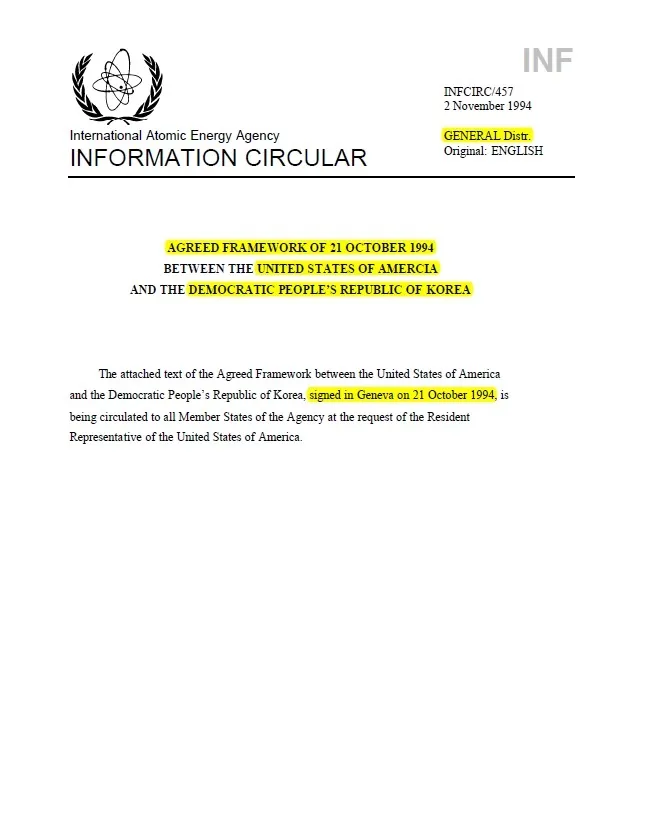
Public domain Public domain false false This text document , published by the United Nations without a copyright notice, was left in the public domain in order to disseminate "as widely as possible the ideas (contained) in the United Nations Publications" ( detail ). It falls into one of the following categories outlined in Administrative Instruction ST/AI/189/Add.9/Rev.2 (paragraph 2): Official records (proceedings of conferences, verbatim and summary records, periodic supplements, compilations of resolutions, etc.) United Nations documents issued with a UN document symbol Public information material designed primarily to inform the public about United Nations activities (not including material that is offered for sale) See Also: {{PD-US-no notice-UN}} to be used by document of the United Nations published in the United States prior to 17 September 1987 and {{PD-UN-map}} for UN maps. · Public domain · Source
When the International Atomic Energy Agency demanded special inspections of the Yongbyon nuclear facilities, North Korea announced on 12 March 1993 that it would leave the Nuclear Non-Proliferation Treaty. Talks with the United States in June put the withdrawal on hold, but the dispute over inspections went on; at inter-Korean working talks in March 1994 the North’s delegate threatened to turn Seoul into “a sea of fire”. When the North announced its withdrawal from the IAEA in June, the United States even considered bombing Yongbyon.
Former US President Jimmy Carter’s meeting with Kim Il Sung in Pyongyang in mid-June eased the crisis, and the two Koreas agreed to hold their first summit in Pyongyang on 25 July. Kim Il Sung’s death on 8 July meant it never took place. On 21 October North Korea and the United States signed the Agreed Framework in Geneva: the North would freeze its nuclear facilities in exchange for two light-water reactors and supplies of heavy fuel oil until they were built.