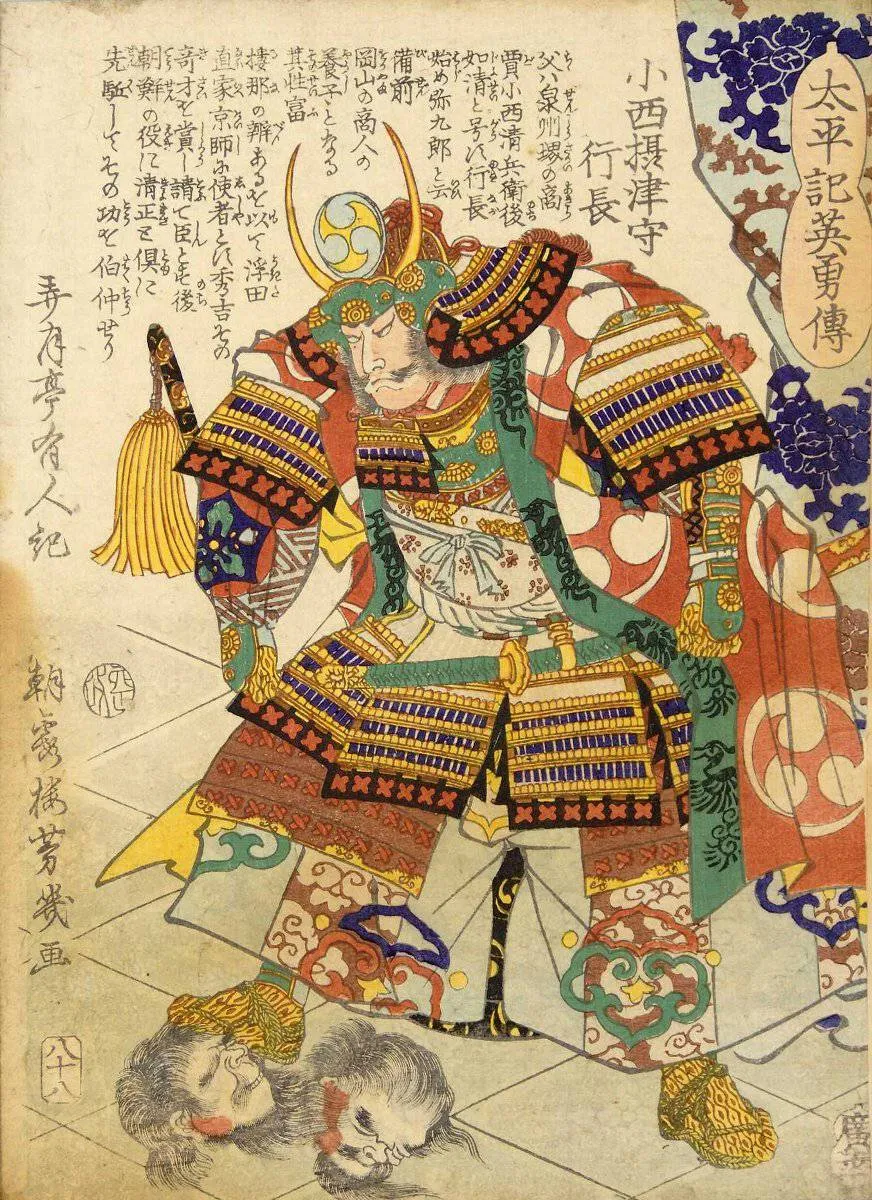
Utagawa Yoshiiku · Public domain · Source
Person1558 – 1600
Konishi Yukinaga
Led the first Japanese division from the Busan landing up to Pyongyang
Utagawa Yoshiiku · Public domain · Source
Led the first Japanese division from the Busan landing up to Pyongyang
The first Japanese division under Konishi Yukinaga landed at Busan and took Busanjin Fortress in a day. Its commander Jeong Bal died defending it.
The day after Busanjin fell, the Japanese surrounded Dongnae. Its magistrate Song Sang-hyeon died resisting, declaring "It is easy to die fighting, hard to let you pass".
Yi Il met the Japanese at Bukcheon, Sangju, with hastily gathered men, who broke before the muskets. Yi fled alone to join Sin Rip at Chungju.
Sin Rip made a stand with a river at his back at Tangeumdae, Chungju, against Konishi Yukinaga’s Japanese army, but was routed and died. When Chungju fell, King Seonjo fled the capital.
Twenty days after landing at Busan, the Japanese entered the capital: Konishi Yukinaga through the East Gate on the 2nd of the fifth month, Kato Kiyomasa through the South Gate on the 3rd.
After King Seonjo left, Konishi Yukinaga’s army crossed the Taedong and took Pyongyang, where it stayed until January 1593.
Ming relief forces under Li Rusong and Joseon troops retook Pyongyang, and Konishi Yukinaga's army fell back south.
Shen Weijing of Ming and Konishi Yukinaga of Japan spent over three years arranging a peace that hid each side’s terms from the other; it collapsed in 1596, and Japan invaded again the next year (the Jeongyu War).
On Hideyoshi’s orders to avenge the defeat of 1592, over 90,000 Japanese surrounded Jinju. It fell after nine days, and some 60,000 soldiers and townspeople inside were killed.
Toyotomi Hideyoshi died at Fushimi Castle in August 1598. Keeping his death secret, Japan ordered its army home from Korea, and the battle of Noryang was fought on the way out.
In 1600 Tokugawa Ieyasu defeated Ishida Mitsunari’s Western Army at Sekigahara, and in 1603 he became shogun and established his government at Edo. The Edo shogunate lasted some 260 years, until 1867.
Commander of the second Japanese division; captured two Korean princes in Hamgyeong and held Ulsan castle in 1597–98
Magistrate of Dongnae who died defending the fortress rather than let the Japanese pass
General who made a back-to-the-river stand at Tangeumdae, Chungju, early in the Imjin War and died when routed by Konishi Yukinaga
Buddhist master who, as supreme commander of monks, raised monk soldiers across the country in the Imjin War and joined the recapture of Pyongyang
Hyujeong's disciple who led monk soldiers in the Imjin War and after the war went to Japan to negotiate and bring captives home
From the Japanese invasion to the Battle of Noryang — the righteous armies, Yi Sun-sin at sea, and Ming intervention
The age when the Ming, shaken by northern raiders, southern pirates and the silver economy, fell to Li Zicheng’s rebels, and the Manchu Qing reached its greatest extent and prosperity under Kangxi, Yongzheng and Qianlong — as Japan was unified out of the Warring States into the Edo shogunate’s bakuhan order and closed country, and Joseon, after two great wars, met its neighbours through embassies to Edo and the Northern Learning
From Wanggeom-seong of Gojoseon to the inter-Korean summits — capital of Goguryeo, Western Capital of Goryeo, the great city on the Taedong
From the Goguryeo stele to Tangeumdae — Jungwon, the middle of the Namhan River route that the Three Kingdoms fought over
Port of the Japan House and of the 1876 opening — Korea’s gateway to Japan, and wartime capital in the Korean War