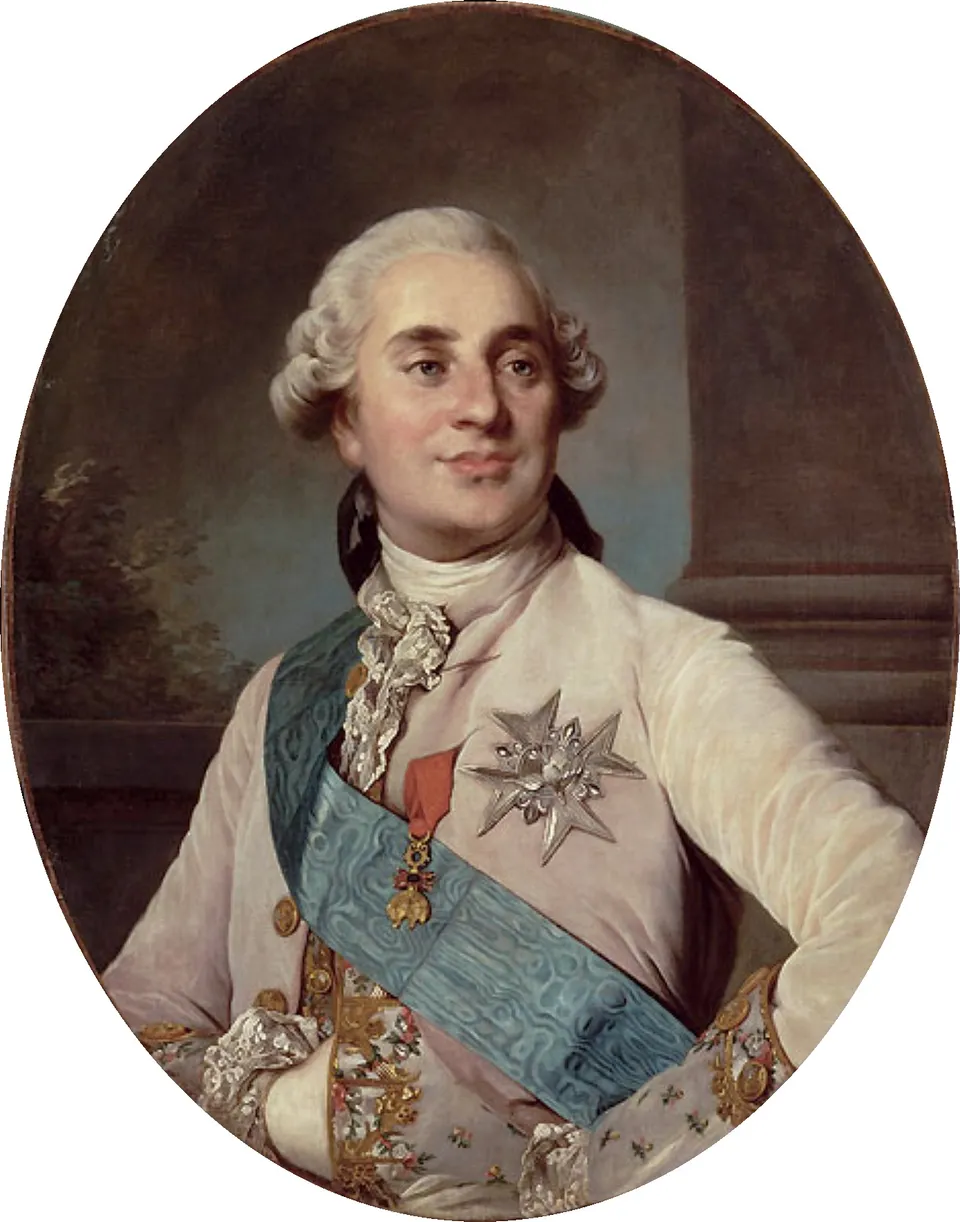
Joseph-Siffred Duplessis / Formerly attributed to Antoine-François Callet · Public domain · Source
Person1754 – 1793
Louis XVI
King of France, executed during the Revolution
Joseph-Siffred Duplessis / Formerly attributed to Antoine-François Callet · Public domain · Source
King of France, executed during the Revolution
The debt-ridden monarchy summoned the Notables in a bid to tax the nobility and clergy, but the privileged orders refused and reform stalled.
At the first Estates-General in 175 years the orders split over how to vote, and the Third Estate proclaimed itself the National Assembly.
Locked out of their hall, the Third Estate deputies gathered in a nearby real-tennis court and swore not to disperse until they had given France a constitution.
Angered by the price of bread, the women of Paris marched to Versailles, broke into the palace and brought the royal family back to the Tuileries in Paris.
A popular revolution overthrew the absolute monarchy and founded a republic, spreading the ideals of liberty, equality and fraternity.
Louis XVI and his family slipped out of Paris to flee to the border but were stopped at Varennes, destroying trust in the king.
France’s first written constitution set up a constitutional monarchy; the king kept a veto, and the vote went only to tax-paying men.
The Paris crowd and provincial volunteers stormed the Tuileries Palace and defeated the Swiss Guards; the king was suspended and the monarchy fell.
The National Convention sentenced “Citizen Louis Capet” to death for treason, and the king was guillotined in the Place de la Révolution.
Cleric and political theorist whose pamphlet What Is the Third Estate? opened the Revolution and who plotted the coup of Brumaire with Napoleon in 1799
Nobleman elected for the Third Estate whose oratory led the early National Assembly towards a constitutional monarchy
Jacobin leader who dominated the Committee of Public Safety during the Reign of Terror and was guillotined after the Thermidorian Reaction of 1794
Queen of France, wife of Louis XVI, born a Habsburg archduchess of Austria; caught in the flight to Varennes and executed in 1793
Controller-General of Finances to Louis XVI (1783–1787) whose plan to tax the privileged orders was rejected by the Assembly of Notables
Genevan banker and finance minister to Louis XVI whose dismissal in July 1789 set off the storming of the Bastille
Nobleman and veteran of the American War of Independence who commanded the Paris National Guard and drafted the Declaration of the Rights of Man, and fled abroad in 1792, only to be held captive by the Austrians
The Scientific Revolution from Copernicus to Newton, parliamentary government in England won through the Puritan and Glorious Revolutions, and the Enlightenment that sought to remake society by reason — the groundwork of the civic revolutions and the Industrial Revolution
From the Declaration of Independence to the German Empire — a century in which liberalism and nationalism toppled the old order in Europe and the Americas and built nation-states
From the Assembly of Notables and the Estates-General to the coup of 18 Brumaire — twelve years that toppled the absolute monarchy, founded a republic, passed through Terror and reaction, and ended with Napoleon