ConflictMay 1803 – 1815

Napoleonic Wars

Also called: Battle of Trafalgar, Battle of Austerlitz, Battle of Leipzig

The wars between Napoleon's France and coalitions of Britain, Austria, Russia and Prussia. France came to dominate most of the Continent but collapsed after the failed invasion of Russia.
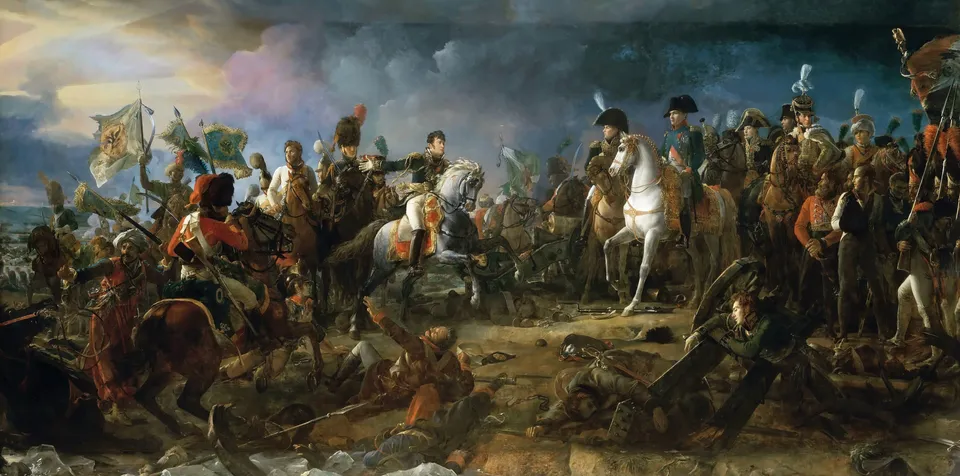
Napoleon at the Battle of Austerlitz, 2 December 1805 — painting by François Gérard, 1810

François Gérard · Public domain · Source

War between Britain and France resumed in 1803 when the Peace of Amiens broke down. In 1805 Nelson’s British fleet destroyed the Franco-Spanish fleet at Trafalgar, ending Napoleon’s plan to invade Britain. On land, however, Napoleon crushed the Austrians and Russians at Austerlitz (1805) and the Prussians at Jena (1806). The Confederation of the Rhine was created in 1806 and the Holy Roman Empire was dissolved.

Napoleon tried to isolate Britain economically with the Continental System and put his brother Joseph on the Spanish throne. But Spanish guerrilla resistance (the Peninsular War) dragged on, and the invasion of Russia failed in 1812. Defeated at Leipzig (the Battle of the Nations) in 1813, Napoleon was exiled to Elba in 1814; he returned the next year only to lose at Waterloo.

The conquests spread revolutionary principles such as the Napoleonic Code and the abolition of feudalism. At the same time resistance to French rule awakened nationalism in Germany (Fichte’s Addresses to the German Nation), Spain and elsewhere. The weakening of Spain set off the independence movements of Latin America.
The map in 1803

OpenFreeMap © OpenMapTiles © OpenStreetMap contributors

States at the time
France · belligerent
Great Britain · belligerent
Austrian Empire · belligerent
Russia · belligerent
Kingdom of Prussia · belligerent
Spain · belligerent
Portugal · belligerent
Holy Roman Empire · dissolved
Confederation of the Rhine · established
Duchy of Warsaw · established
Napoleonic Italy

People

  • Napoleon Bonaparte1769 – 1821

    commander · Revolutionary general, later Emperor of the French

  • Duke of Wellington1769 – 1852

    commander · Arthur Wellesley, British general and statesman who drove the French out of the Iberian Peninsula and defeated Napoleon at Waterloo in 1815; later prime minister

  • Alexander I of Russia1777 – 1825

    monarch · Emperor of Russia (1801–1825) who defeated Napoleon's invasion, attended the Congress of Vienna in person and proposed the Holy Alliance

  • Mikhail Kutuzov1745 – 1813

    commander · Russian field marshal who fought Napoleon's army at Borodino in 1812, gave up Moscow and then pursued and shattered the retreating French

3 parts of this event

  1. 1

    With the Berlin Decree Napoleon banned trade between continental Europe and Britain, hoping to bring down by economics the country he could not defeat at sea.

  2. 2

    Napoleon led a vast army to punish Russia for breaking the Continental System and reached Moscow, but scorched-earth tactics and the winter cold destroyed most of his army on the retreat.

  3. 3

    Napoleon, who had escaped Elba and become emperor again, was defeated at Waterloo in Belgium by Wellington’s Anglo-allied army and Blücher’s Prussians. The Hundred Days and the Napoleonic era came to an end.

Before and after

Earlier
1791 Haitian Revolution

Related works

  • Film: NapoleonDramatizedFilm · 2023 · Ridley Scott
  • Book: War and PeaceDramatizedBook · 1869 · Leo Tolstoy · Война и мир

Dramatized works (films, dramas, novels) may differ from the historical record.

Themes that include this event

  • Revolutions and Nation-States1776 – 1871

    From the Declaration of Independence to the German Empire — a century in which liberalism and nationalism toppled the old order in Europe and the Americas and built nation-states