Conflict24 June – December 1812

Napoleon's Invasion of Russia

Also called: Battle of Borodino, Russian campaign of 1812

Napoleon led a vast army to punish Russia for breaking the Continental System and reached Moscow, but scorched-earth tactics and the winter cold destroyed most of his army on the retreat.
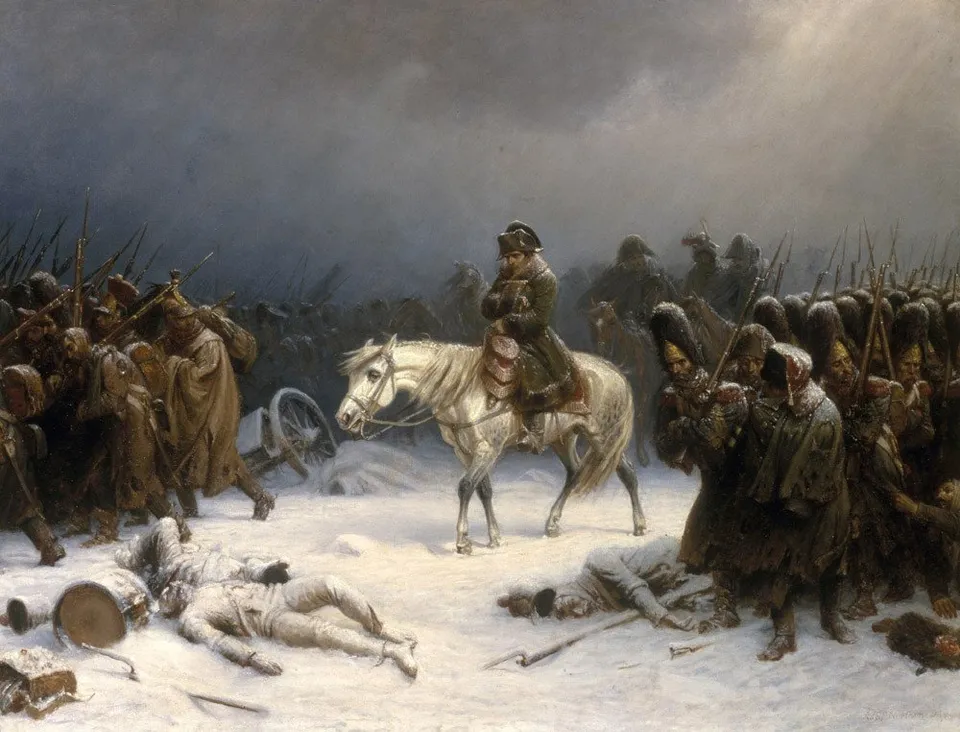
Napoleon and his army retreating from Moscow — painting by Adolph Northen, 1851

Adolph Northen · Public domain · Source

On 24 June 1812 Napoleon crossed the Neman with a multinational army of around 600,000. The Russians avoided battle and fell back, burning villages and crops as they went (scorched earth). After a bloody battle at Borodino on 7 September, Kutuzov abandoned Moscow. The city Napoleon entered was largely destroyed by fire, and Alexander I refused to negotiate.

Leaving Moscow in October, the army suffered hunger, bitter cold and attacks by Russian troops and peasant partisans, with heavy losses at the crossing of the Berezina in November. Only some tens of thousands made it back. The disaster brought Prussia and Austria back to Russia’s side (the War of Liberation), and Napoleon’s empire began to fall apart.
The map in 1812

OpenFreeMap © OpenMapTiles © OpenStreetMap contributors

States at the time
France · invader
Russia · invaded
Duchy of Warsaw · intervened

People

  • Napoleon Bonaparte1769 – 1821

    commander · Revolutionary general, later Emperor of the French

  • Mikhail Kutuzov1745 – 1813

    commander · Russian field marshal who fought Napoleon's army at Borodino in 1812, gave up Moscow and then pursued and shattered the retreating French

  • Alexander I of Russia1777 – 1825

    monarch · Emperor of Russia (1801–1825) who defeated Napoleon's invasion, attended the Congress of Vienna in person and proposed the Holy Alliance

Before and after

Earlier
1806 Continental System

Related works

  • Book: War and PeaceDramatizedBook · 1869 · Leo Tolstoy · Война и мир

Dramatized works (films, dramas, novels) may differ from the historical record.

Themes that include this event

  • Revolutions and Nation-States1776 – 1871

    From the Declaration of Independence to the German Empire — a century in which liberalism and nationalism toppled the old order in Europe and the Americas and built nation-states