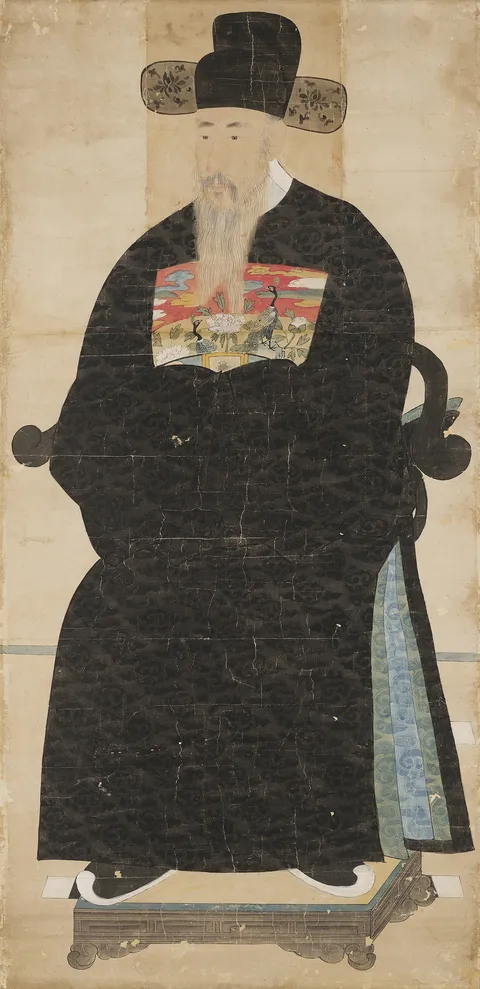
Person1580 – 1658

Kim Yuk

Chief State Councillor under Hyojong who extended the Uniform Land Tax Law and urged adoption of the Shixian calendar and minting of coins

A Westerner, he worked to ease the burden on the people by extending the Daedong law, overcoming opposition to have it applied in Chungcheong in 1651 and in the coastal districts of Jeolla in 1658. He promoted carts and waterwheels, and the Shixian calendar based on Western astronomy was adopted in 1653. Urging wider use of coins, he proposed minting the Sangpyeong tongbo.
Where they went

OpenFreeMap © OpenMapTiles © OpenStreetMap contributors

2 related events

  1. 1
    1608Daedong lawleader

    Tribute in local goods was replaced by a tax in rice levied on land; begun in Gyeonggi, it took a century to cover the whole country.

  2. 2

    On Kim Yuk’s advice Joseon adopted the Shixian calendar, made in Qing on the basis of Western astronomy.

Related works

  • TV episode: The Day: History Journal Episode 57: For the People's Livelihood: Kim Yuk Defends the Daedong LawTV episode · 2014 · KBS1

People who appear alongside

  • Gwanghaegun1575 – 1641

    Fifteenth king of Joseon who began the Daedong law and balanced Ming and the Later Jin; deposed in 1623

  • Yi Won-ik1547 – 1634

    Chief state councillor who proposed the Daedong tax reform

  • Hyojong1619 – 1659

    Seventeenth king of Joseon; a former hostage in Qing who planned a northern campaign and sent troops against Russia

Themes this person appears in

  • Changes in TaxationAD 755 – 1894

    From land tax, tribute and labour to cash taxes in the Gabo Reform — burdens shifting from people and households to land

  • Ming, Qing and Edo Japan1500 – 1800

    The age when the Ming, shaken by northern raiders, southern pirates and the silver economy, fell to Li Zicheng’s rebels, and the Manchu Qing reached its greatest extent and prosperity under Kangxi, Yongzheng and Qianlong — as Japan was unified out of the Warring States into the Edo shogunate’s bakuhan order and closed country, and Joseon, after two great wars, met its neighbours through embassies to Edo and the Northern Learning

  • Scientific Revolution, Enlightenment and the English Revolutions1543 – 1796

    The Scientific Revolution from Copernicus to Newton, parliamentary government in England won through the Puritan and Glorious Revolutions, and the Enlightenment that sought to remake society by reason — the groundwork of the civic revolutions and the Industrial Revolution