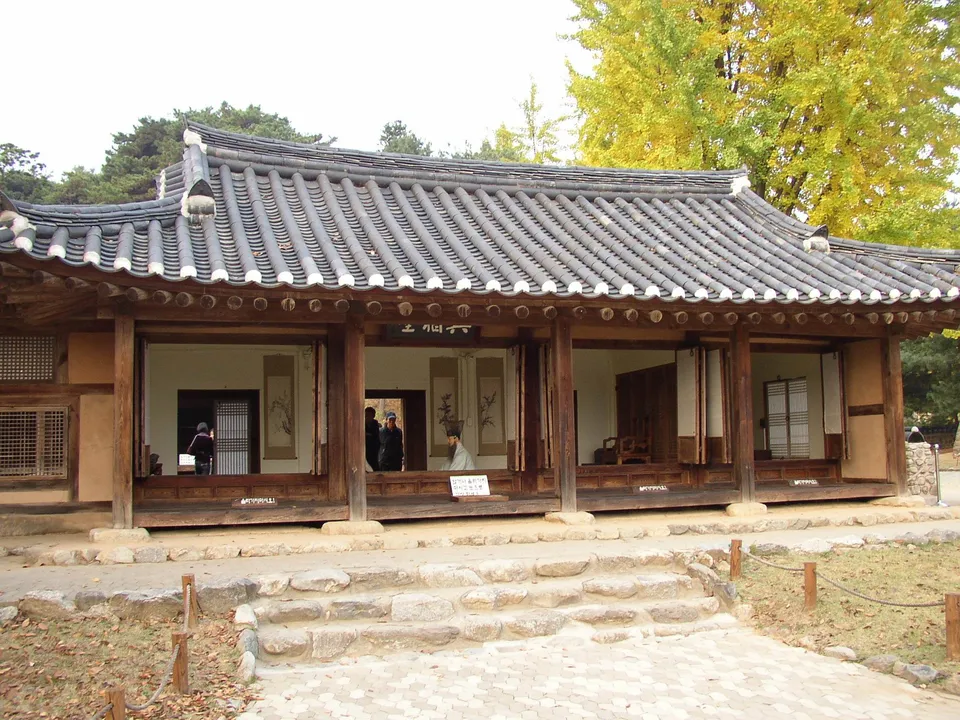
Yeoyudang, Jeong Yak-yong’s home, Dasan historic site, Namyangju

Seonjong Park (Nichetas) · CC BY-SA 3.0 · Source

Person1762 – 1836

Jeong Yak-yong (Dasan)

Silhak scholar who helped design Hwaseong; exiled to Gangjin, where he wrote the Mongmin simseo

A Southerner, he carried on Yi Ik's learning and brought Silhak to its height. Trusted by Jeongjo, he designed the crane (geojunggi) used to build Hwaseong Fortress and a pontoon bridge over the Han. Exiled to Gangjin in the Catholic Persecution of 1801, he spent 18 years there writing the Mongmin simseo on the duties of local officials, the Gyeongse yupyo on reforming central institutions and the Heumheum sinseo on criminal law. He proposed the yeojeon system, in which villages would farm land jointly and share the harvest by labour. He also wrote the Magwa hoetong and the Abang gangyeokgo; his works are collected in the Yeoyudang jeonseo.
Where they went

OpenFreeMap © OpenMapTiles © OpenStreetMap contributors

4 related events

  1. 1

    At Ubandong in Buan, Yu Hyeong-won completed Bangye surok, proposing to distribute land by social status — the start of the agrarian school of Silhak.

  2. 2
    1794 – 1796Hwaseong Fortress builtparticipant

    Jeongjo built a new fortress at Suwon, where he had moved his father’s tomb. Jeong Yak-yong helped design it and introduced a crane; the work was recorded in a detailed royal protocol.

  3. 3

    Queen Jeongsun banned Catholicism and had Yi Seung-hun and about a hundred believers executed; Jeong Yak-yong and his brother were exiled.

  4. 4

    In exile at Gangjin, Jeong Yak-yong completed the 48-volume Mongmin simseo, a guide for magistrates on governing the people.

Related works

People who appear alongside

  • Yu Hyeong-won1622 – 1673

    Pioneer of agrarian Silhak who wrote Bangye surok at Ubandong in Buan, proposing land redistribution graded by status (gyunjeon-ron)

  • Yi Ik1681 – 1763

    Silhak scholar, author of Seongho saseol, who proposed an inalienable minimum holding of land (hanjeon-ron) and listed six “vermin” eating away the state

  • Jeongjo1752 – 1800

    Twenty-second king of Joseon, founder of the Gyujanggak library and builder of Hwaseong Fortress

  • Queen Jeongsun1745 – 1805

    Regent for the young Sunjo who launched the 1801 persecution of Catholics

  • Sunjo1790 – 1834

    Twenty-third king of Joseon, whose reign under in-law clan rule saw the Hong Gyeong-nae rebellion

  • Yi Seung-hun1756 – 1801

    First Korean baptized a Catholic, in Beijing in 1784; he founded the first Korean Catholic community and was executed in 1801

  • Jeong Yak-jeon1758 – 1816

    Jeong Yak-yong's elder brother who, exiled to Heuksando in the Catholic Persecution of 1801, surveyed its sea life in the Jasan eobo

Themes this person appears in

  • Islamic Empires and the Atlantic World1500 – 1800

    Three centuries in which the Ottomans of Suleiman I, the Mughals of Akbar and the Safavids of Abbas I flourished and then faltered, while across the Atlantic the slave trade and colonies transformed the Americas, leading to American independence

  • Reformation and Absolutism1517 – 1796

    From Luther’s Ninety-five Theses to Catherine the Great — the wars of religion of a divided Christendom ended at Westphalia, and absolute monarchs armed with divine right, standing armies, bureaucracies and mercantilism, followed by the enlightened despots of eastern Europe, contended for the balance of power among sovereign states

  • Changes in Architecture1200 – 1910

    From Geungnakjeon at Bongjeongsa to Seokjojeon at Deoksugung — Goryeo bracket styles, Joseon palaces, walls and multi-storey temple halls, and the Western buildings of the Korean Empire

  • Science and Technology HeritageAD 633 – 1861

    From Cheomseongdae to the Daedong yeojido — instruments and maps that measured the sky, kept time, gauged rain and charted the land

  • Intangible and World Heritage2000 BC – 1850

    From the dolmens to Namhansanseong on the World Heritage List, from Jongmyo ritual music to ssireum on the Intangible Heritage lists — where each came from and when it was inscribed

  • Suwon1601 – 1919

    From Jeongjo’s new city of Hwaseong to the tragedy of Jeam-ri — where a king’s filial devotion and reform politics were built into stone walls