Changing Unification Policies
From “march north” to the Panmunjom Declaration — inter-Korean relations from confrontation to dialogue, through joint statements and agreements to summits (up to 2018)
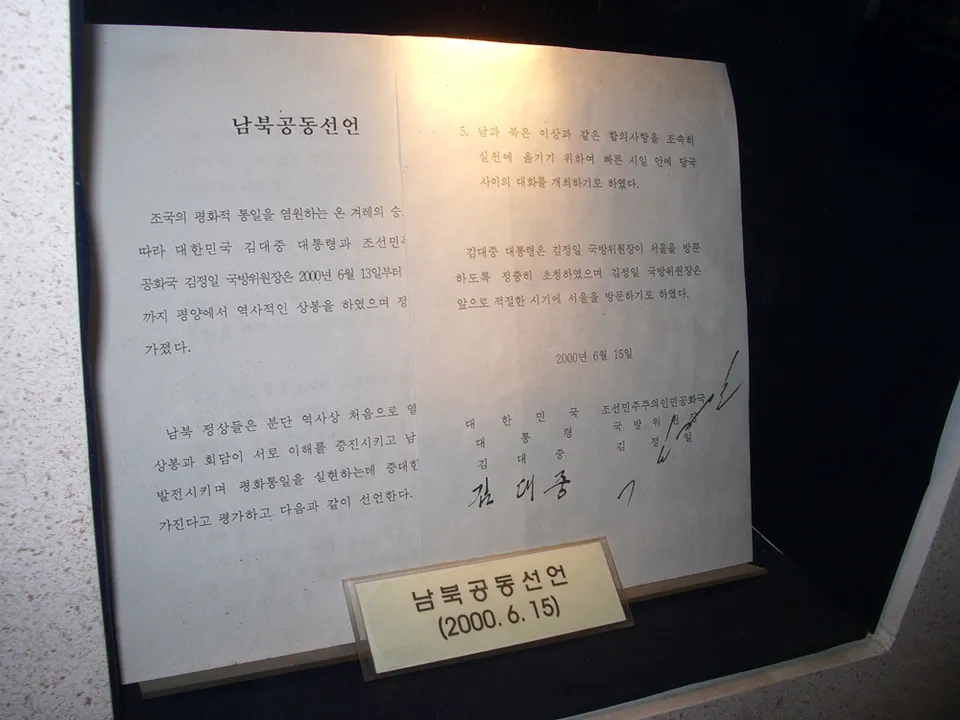
InSapphoWeTrust · CC BY-SA 2.0 · Source
From “march north” to the Panmunjom Declaration — inter-Korean relations from confrontation to dialogue, through joint statements and agreements to summits (up to 2018)

InSapphoWeTrust · CC BY-SA 2.0 · Source
| Government | Year | What happened |
|---|---|---|
| Syngman Rhee | 1950s | “March north” policy; peaceful-unification Progressives crushed |
| Chang Myon | 1960–61 | UN-supervised all-Korea elections; student talks movement |
| Park Chung-hee | 1972 | July 4 Joint Statement — independence, peace, unity; coordinating committee |
| Chun Doo-hwan | 1985 | First hometown visits of separated families; arts troupes |
| Roh Tae-woo | 1988 | July 7 Declaration; Nordpolitik (USSR, China ties) |
| Roh Tae-woo | 1991 | Joint UN entry; Basic Agreement; Denuclearization Declaration |
| Kim Young-sam | 1994 | National Community Formula (cooperation → commonwealth → one state) |
| Kim Dae-jung | 1998 | Sunshine Policy; Chung Ju-yung’s cattle; Mount Geumgang tours |
| Kim Dae-jung | 2000 | First summit; June 15 Joint Declaration |
| Roh Moo-hyun | 2003 | Kaesong Industrial Complex begun; rail links |
| Roh Moo-hyun | 2007 | Second summit; October 4 Declaration |
| Moon Jae-in | 2018 | April 27 Panmunjom Declaration; Sept. 19 Pyongyang Declaration |
Opposing a separate election in the south, Kim Gu and Kim Gyu-sik met northern leaders in Pyongyang, without result.
Cho Bong-am of the Progressive Party, which called for peaceful unification, was executed on espionage charges and the party dissolved; he was acquitted on retrial in 2011.
After the April Revolution the constitution was changed to a parliamentary, bicameral system, and Chang Myon of the victorious Democratic Party became prime minister.
For the first time since division, the two Koreas agreed on three principles of unification — independence, peace and national unity — announced simultaneously in Seoul and Pyongyang.
For the first time since division, groups of separated family members and performing artists from South and North visited Seoul and Pyongyang.
The Roh Tae-woo government expanded ties with the communist bloc, establishing relations with the Soviet Union (1990) and China (1992).
At the 46th UN General Assembly, North and South Korea became members of the United Nations together.
The two Koreas adopted an agreement recognizing each other’s systems and pledging non-aggression, exchanges and cooperation, followed by a joint declaration on denuclearization.
The Kim Young-sam government proposed a three-stage path to unification: reconciliation and cooperation, a South–North commonwealth, and a unified state.
After Chung Ju-yung crossed into North Korea with a herd of cattle, a ship carrying South Korean tourists sailed from Donghae for Mount Geumgang.
The first inter-Korean summit since division was held in Pyongyang, and a joint declaration was issued.
After the June 15 Declaration, an industrial zone combining southern capital and technology with northern land and labour was built at Kaesong.
President Roh Moo-hyun and Chairman Kim Jong Il held the second inter-Korean summit in Pyongyang and issued a declaration on inter-Korean development and peace and prosperity.
President Moon Jae-in and Chairman Kim Jong Un met at Panmunjom and issued the Panmunjom Declaration for Peace, Prosperity and Unification of the Korean Peninsula.
13th President (1988–1993). Announced the June 29 Declaration, became the first president directly elected under the 1987 constitution, and pursued Nordpolitik
Leader of North Korea (1948–1994): chairman of the Provisional People’s Committee, then premier and president. Purged rivals after the Korean War and built one-man rule
15th President (1998–2003), the first transfer of power to the opposition by election. Steered recovery from the currency crisis and held the first inter-Korean summit; Nobel Peace Prize 2000
Son of Kim Il Sung and leader of North Korea (1994–2011). Named successor in 1980; ruled as chairman of the National Defence Commission under "military-first" politics. North Korea gives his birth year as 1942
16th President (2003–2008). Held the second inter-Korean summit in Pyongyang in 2007 and issued the October 4 Declaration
Known as Baekbeom; founded the Korean Patriotic Organization and led the Liberation Army as Chairman of the Provisional Government
Envoy of the New Korea Youth Party to the Paris Peace Conference, later Vice-Chairman of the Provisional Government
First Minister of Agriculture; ran for president in 1956 and founded the Progressive Party calling for peaceful unification. Executed in 1959 in the Progressive Party case, acquitted on retrial in 2011
First President of the Provisional Government, who worked through diplomacy in the US; later first President of the Republic of Korea
Elected vice president in 1956; prime minister under the parliamentary system after the April Revolution (1960–1961)
4th President (1960–1962), elected by the National Assembly under the parliamentary system after the April Revolution; resigned after the May 16 coup
Politician who led the caretaker government after Syngman Rhee resigned in the April Revolution, overseeing the parliamentary-system amendment and the 29 July election