Local history2000 BC – 137610 events
Buyeo
From the Songguk-ri village to Sabi, Baekje’s last capital — the Geum River town where Baekje culture bloomed and fell
From the Songguk-ri village to Sabi, Baekje’s last capital — the Geum River town where Baekje culture bloomed and fell
| Period | Event | Key points |
|---|---|---|
| Bronze Age | Songguk-ri site | Moated, palisaded village; plain pottery |
| Baekje | Dongseong assassinated | Killer sent by Baek Ga of Garimseong |
| Baekje | Capital to Sabi | King Seong, 538; “Nambuyeo”; 22 offices |
| Baekje | Buddhism to Wa | King Seong; Norisachigye |
| Baekje | Gilt-bronze incense burner | Neungsan-ri temple site, 1993; Taoist, Buddhist |
| Baekje | Jeongnimsa pagoda | Wooden-pagoda style; Su Dingfang’s inscription |
| Baekje | Fall of Baekje | Sabi falls, 660; Uija surrenders |
| Baekje | Baekje restoration | Boksin, Dochim, Heukchi Sangji; Sabi besieged |
| Baekje | Battle of Baekgang | Wa fleet destroyed, 663; Geum estuary |
| Late Goryeo | Battle of Hongsan | Choe Yeong routs Japanese pirates, 1376 |
Bronze came into use around 2000–1500 BCE. Rice farming began, private property and classes emerged, and chieftains came to rule.
Out hunting west of Sabi, King Dongseong was stabbed by an assassin sent by Baekga, lord of Garim Fortress; King Muryeong succeeded him.
King Seong moved the capital to Sabi (Buyeo) on the Geum River plain and renamed the country Nambuyeo ("Southern Buyeo").
King Seong sent the envoy Norisachigye with Buddhist images and sutras to Wa; Baekje culture strongly influenced the formation of Japan’s Asuka culture.
A Baekje censer found in 1993 at a temple site in Neungsan-ri, Buyeo — held up by a dragon and crowned by a phoenix, its lid carved with an immortals’ paradise.
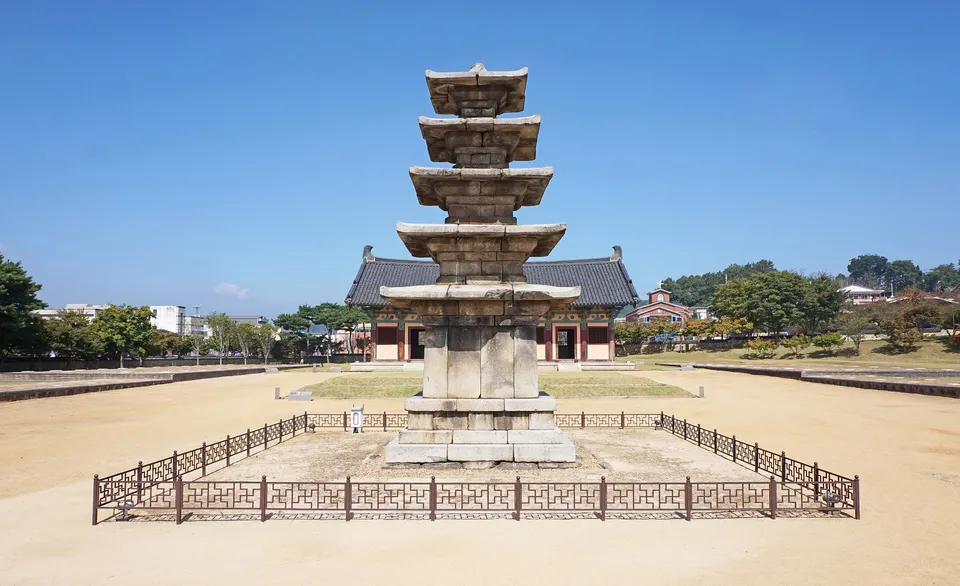
A Baekje stone pagoda on the site of Jeongnimsa in the heart of the Sabi capital — the refined culmination of Baekje’s stone pagodas modelled on timber ones.
Boksin, Dochim and Heukchi Sangji rose at Juryu and Imjon fortresses, crowned Prince Buyeo Pung, recalled from Wa, and fought the Silla–Tang allies.
Allied Silla and Tang forces took the capital Sabi, and King Uija surrendered, ending Baekje.
A Wa fleet sent to aid the Baekje rebels was crushed by the Silla–Tang allies at the mouth of the Baek River; 400 ships burned.
Choe Yeong routed Japanese pirates at Hongsan in Buyeo.
Twenty-sixth king of Baekje, who moved the capital to Sabi and died at Gwansan Fortress
Son of King Uija, brought back from Wa as king by the Baekje restoration forces, who fled to Goguryeo after the defeat at Baekgang
Twenty-fourth king of Baekje, who allied with Silla by marriage and was killed by an assassin
Twenty-fifth king of Baekje, who sent royal kin to the 22 damno districts and revived the kingdom
Baekje scholar said to have gone to Wa around the reign of King Geunchogo, taught Chinese writing to the crown prince and recommended Wang In
Baekje scholar said to have brought the Analects and the Thousand Character Classic to Wa and taught Chinese writing
Goguryeo monk and painter who went to Japan in 610 and taught the making of paper, ink and millstones
Baekje royal who led the restoration movement and brought Prince Buyeo Pung back from Wa
Baekje general who led restoration forces at Imjon Fortress before surrendering to Tang
Baekje monk who raised the Baekje restoration movement at Juryuseong with Boksin, who later killed him
Last king of Baekje, who took Daeya Fortress from Silla but surrendered to the Silla–Tang allies