Culture7th century

Five-story Stone Pagoda at the Jeongnimsa Temple Site, Buyeo

Also called: Jeongnimsa Pagoda

A Baekje stone pagoda on the site of Jeongnimsa in the heart of the Sabi capital — the refined culmination of Baekje’s stone pagodas modelled on timber ones.
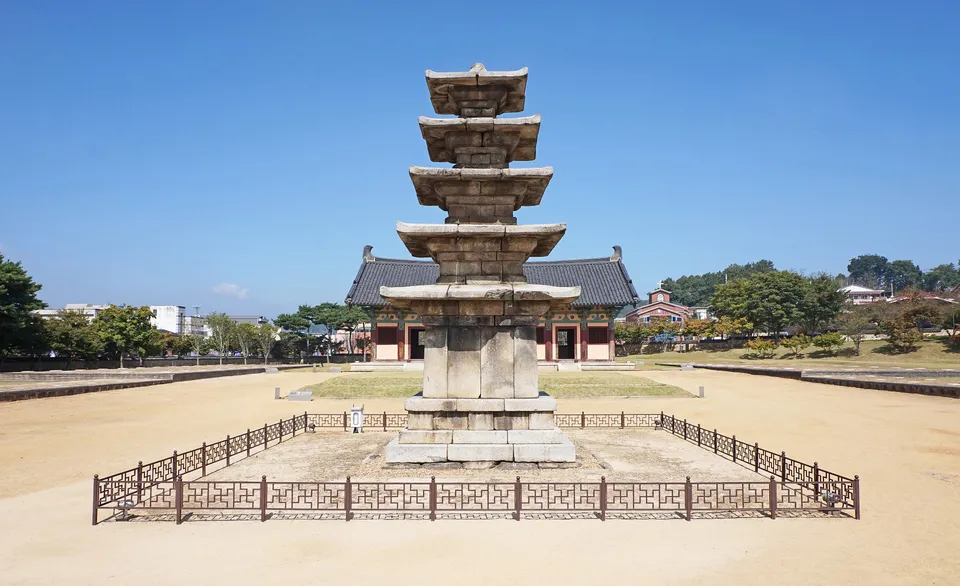
Five-story stone pagoda at the Jeongnimsa temple site, Buyeo — a Baekje pagoda translating timber forms into stone

Bernard Gagnon · CC0 · Source

This 8.3 m five-story pagoda stands on the site of Jeongnimsa, which lay in the middle of the Sabi (Buyeo) capital. Its corner pillars swell slightly in the middle and its broad, thin roof stones lift gently at the tips, rendering a timber pagoda in stone. Where the Mireuksa pagoda translated a timber pagoda almost literally, Jeongnimsa refined it into a simple, balanced form, and is counted the culmination of Baekje stone pagodas.

Su Dingfang, the Tang general who destroyed Baekje in 660, had an inscription celebrating the Tang conquest of Baekje carved on its ground story, so it was once wrongly called the "Pagoda of the Conquest of Baekje". It and the Mireuksa pagoda are the only stone pagodas Baekje left. It is a National Treasure and became World Heritage in 2015 as part of the Baekje Historic Areas.

The map in AD 650

OpenFreeMap © OpenMapTiles © OpenStreetMap contributors

States and rulers at the time
Baekje — King Uija
Places
Sabi (Busosanseong)

People

  • Su DingfangAD 592 – AD 667

    related figure · Tang general who crossed the sea with 130,000 troops to attack Baekje

Before and after

Earlier
AD 650 Baekje Landscape Tile

Themes that include this event

  • Changes in PagodasAD 634 – 1467

    From Baekje stone pagodas copying timber ones and Silla pagodas copying brick ones, to Unified Silla three-story pagodas and stupas, Goryeo multi-sided pagodas and Yuan-influenced marble towers

  • Intangible and World Heritage2000 BC – 1850

    From the dolmens to Namhansanseong on the World Heritage List, from Jongmyo ritual music to ssireum on the Intangible Heritage lists — where each came from and when it was inscribed

  • Buyeo2000 BC – 1376

    From the Songguk-ri village to Sabi, Baekje’s last capital — the Geum River town where Baekje culture bloomed and fell