Destruction of Troy
Also called: Fall of Troy, Troy VIIa, Sack of Troy
Around 1180 BC the city of Troy (layer Troy VIIa) on the mound of Hisarlik in north-western Anatolia burned and fell. Who destroyed it, and whether the Trojan War of Homer ever took place, are still debated.
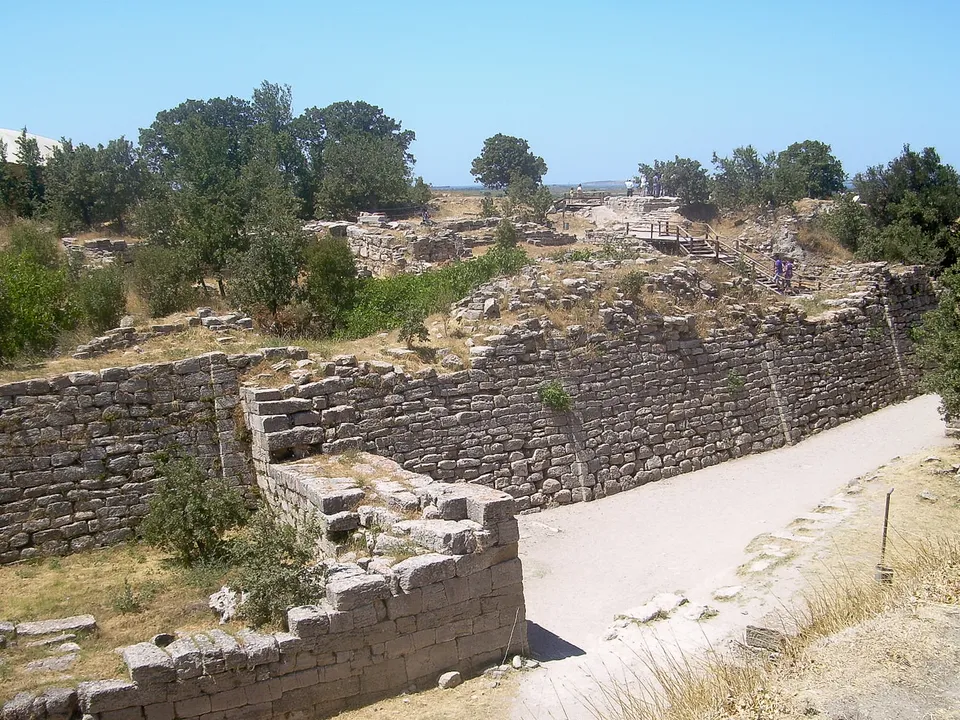
CherryX · CC BY-SA 3.0 · Source
The mound of Hisarlik, overlooking the mouth of the Dardanelles, holds nearly ten layers of settlement, from about 3000 BC to the Roman city of Ilion. Troy VI (c. 1750–1300 BC), with its high walls and broad lower town, collapsed around 1300 BC — by an earthquake, in the view of its excavator Carl Blegen. Troy VIIa, rebuilt on top, was destroyed by fire around 1190–1180 BC; arrowheads and unburied human remains have led many to read it as a destruction by war. This was the time of the Late Bronze Age collapse, when the Hittite Empire and the Mycenaean palace kingdoms fell one after another.
Hittite records mention a kingdom called Wilusa in north-western Anatolia and its king Alaksandu, as well as interference in the region by Ahhiyawa from across the western sea. Many scholars equate Wilusa with Greek (W)ilios, i.e. Troy, and Ahhiyawa with Homer’s Achaeans (Greeks), though not all accept this. The ancient Greek scholar Eratosthenes reckoned the fall of Troy to 1184 BC.
Archaeology shows that Troy was real and burned at the end of the Bronze Age, but there is no evidence that this was a ten-year war of a Greek coalition to recover Helen. Whether Mycenaean Greeks, some other power or internal strife destroyed Troy VIIa is unknown. Many scholars think Homer’s epics may preserve some memories of the age but are not a historical record. The site of Troy became a UNESCO World Heritage Site in 1998.