The Homeric Epics Take Shape
Also called: Iliad, Odyssey, Homer
Around the 8th century BC, in Ionia on the west coast of Asia Minor, the Iliad, on the Trojan War, and the Odyssey, on Odysseus’ homecoming, took their present form. Songs long passed on by word of mouth were written down in the newly adopted Greek alphabet and became the beginning of Western literature.
Public domain · Source
Since antiquity the Iliad and the Odyssey have been attributed to Homer. Both are poems in dactylic hexameter, mainly in the Ionic dialect, and many scholars think they reached their present form between the late 8th and early 7th century BC, the Odyssey somewhat later. In the 1920s and 1930s the American scholar Milman Parry, studying fixed epithets such as “swift-footed Achilles”, showed that the epics grew out of a tradition of oral poetry composed and sung without writing over generations. Around the 8th century BC these songs came to be written in the Greek alphabet, adapted from the Phoenician script.
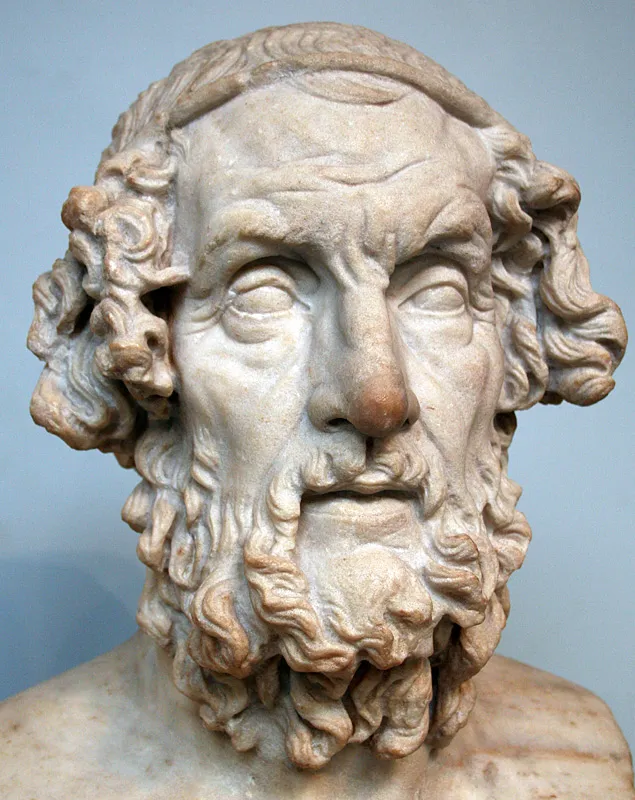
Who Homer was is unknown. Tradition made him a blind poet, and several cities, among them Smyrna and Chios, claimed to be his birthplace; whether one poet composed both epics was debated even in antiquity. In Athens the epics were recited at the Panathenaic festival in the 6th century BC, and the division of each into twenty-four books was the work of Hellenistic scholars at Alexandria.
The two epics became the schoolbooks of the Greeks, shaping their picture of gods and heroes and the values of honour and homecoming, and through Virgil’s Aeneid they influenced all of Western literature. The world they depict mixes memories of the Mycenaean age with the poet’s own time, so they cannot be read directly as history.