Aeneas Flees Troy
Also called: Aeneas, Flight of Aeneas, Aeneas and Anchises
A legend handed down over the centuries.
A Greek and Roman myth sung in Book 2 of Virgil’s Aeneid. On the night Troy burned, the Trojan prince Aeneas escaped the flames carrying his old father Anchises on his shoulders and leading his young son Ascanius by the hand, bearing with them the city’s household gods (the Penates).
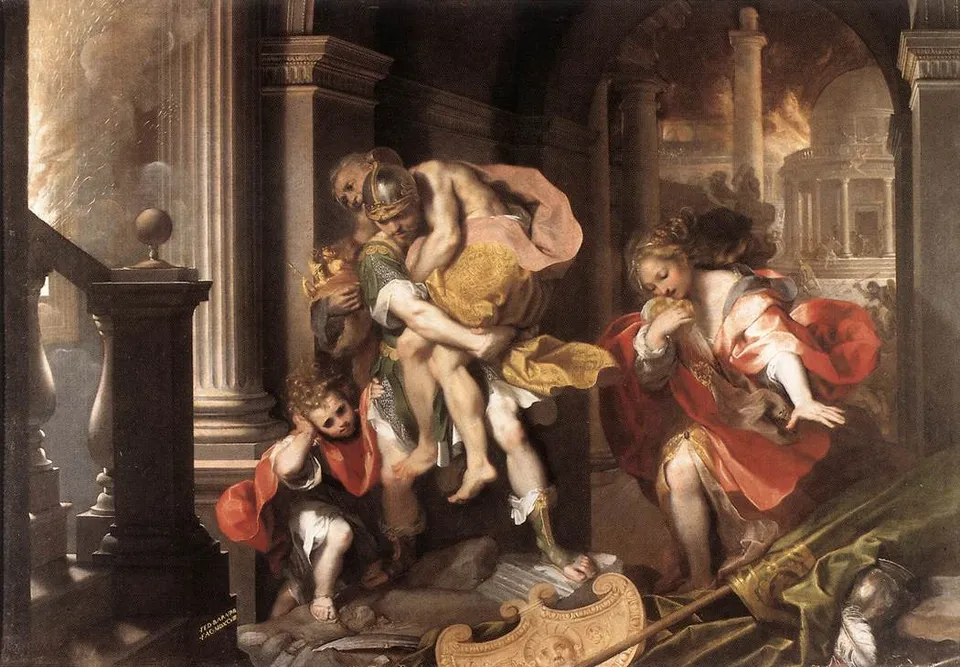
Federico Barocci · Public domain · Source
This Greek and Roman myth is told most fully in Book 2 of the Roman poet Virgil’s Aeneid. Aeneas was the son of Anchises, of the Trojan royal house, and the goddess Aphrodite (the Roman Venus), and already in Homer’s Iliad he fights for Troy. In Book 20 of the Iliad Poseidon saves him from Achilles’ spear and prophesies that Aeneas and his descendants will rule over the Trojans.
In the Aeneid, on the night the Greeks emerge from the wooden horse and set Troy ablaze, Aeneas gives up the fight at the urging of Hector’s ghost in a dream and of his mother Venus. Carrying old Anchises on his shoulders — Anchises holding the Penates, the guardian gods of Troy — and leading his little son Ascanius (Iulus) by the hand, he makes his way out through the fire. His wife Creusa, following behind, is lost in the darkness; her ghost foretells that he will found a new kingdom in Hesperia, the western land of Italy. The image of the son carrying his father became the emblem of pietas (dutiful devotion); it appears on Greek vases from about the 6th century BC, many of them found in Etruria.
The Julian family claimed Iulus as its ancestor, and through him Caesar and Augustus boasted descent from Venus and Aeneas. Archaeology shows only that Troy burned at the end of the Bronze Age; Aeneas’ escape is not confirmed. Here it is placed as a legend attached to the real destruction of Troy, dated to the year Eratosthenes reckoned for its fall.