Second Opium War and Treaties of Tianjin and Beijing
Also called: Arrow War, Convention of Peking
Using the Arrow incident as a pretext, Britain and France attacked Qing China and occupied Beijing. Under the treaties of Tianjin and Beijing China opened more ports, while Russia, acting as mediator, gained the Maritime Province and came to share a border with Korea.
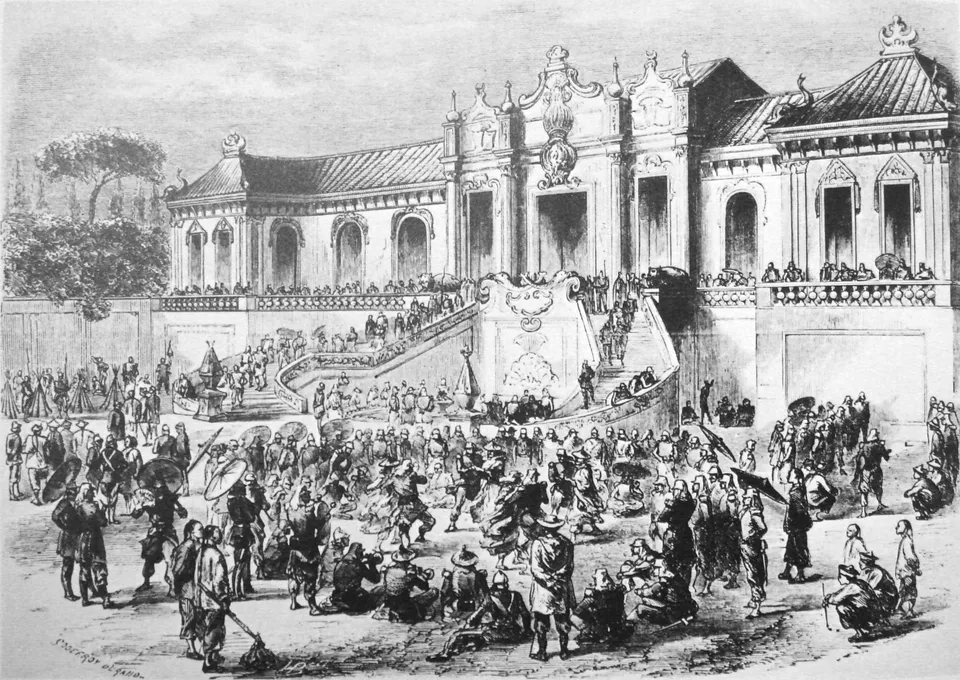
Godefroy Durand · Public domain · Source
Trade had not grown as Britain hoped after the Treaty of Nanjing, and it sought more privileges. In 1856 Britain went to war over the Qing search of the British-flagged Arrow, and France joined over the execution of a missionary. The allies took Guangzhou, moved north and imposed the Treaty of Tianjin in 1858; when the Qing delayed ratification, they occupied Beijing in 1860 and looted and burned the Old Summer Palace (Yuanmingyuan). The Xianfeng Emperor fled to Rehe.
By the Convention of Beijing (1860) China opened Tianjin, ceded the southern Kowloon peninsula to Britain, and accepted foreign envoys in Beijing, freedom for Christian missions and foreign travel in the interior. Russia, the mediator, having gained the land north of the Amur by the Treaty of Aigun (1858), now took the Maritime Province east of the Ussuri and founded Vladivostok.
Russia thus came to border Korea on the lower Tumen River. The next year the Qing set up the Zongli Yamen to handle foreign affairs and embarked on the Self-Strengthening Movement. The fall of Beijing also shocked Korea and deepened the Heungseon Daewongun’s wariness of the West.