Crimean War
Also called: Siege of Sevastopol, Treaty of Paris (1856)
When Russia, seeking to expand southward, went to war with the Ottoman Empire, Britain, France and Sardinia sided with the Ottomans. Russia lost Sevastopol and the war, and its southward drive was checked.
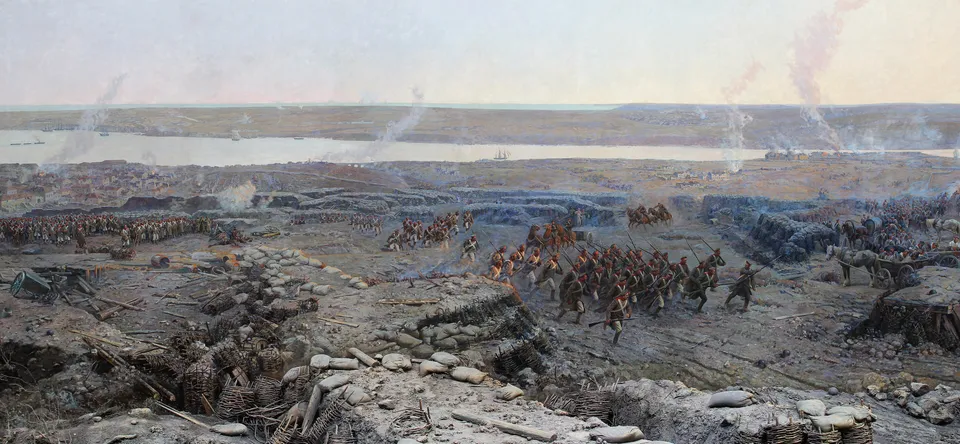
Russia pressed the weakening Ottoman Empire to win an outlet to the Mediterranean (its southward policy). Citing the custody of the holy places in Jerusalem and the protection of Orthodox Christians in the empire, Russia occupied the Danubian principalities in 1853, and the Ottomans declared war. Fearing Russian control of the Black Sea, Britain and France joined in 1854, and Sardinia sent troops in 1855. The allies besieged the Crimean naval base of Sevastopol for nearly a year before taking it in September 1855.
The Treaty of Paris (1856) neutralized the Black Sea. Far more soldiers died of disease than in battle, and Florence Nightingale reformed sanitation in the military hospitals. It was also a modern war, reported almost as it happened by telegraph, war correspondents and photographers. Defeat showed Russia how backward it was and led to reforms such as the emancipation of the serfs; Russia also turned east, gaining the Maritime Province by the Treaty of Beijing in 1860 and so coming to border Joseon Korea.