February Revolution
Also called: French Revolution of 1848, Second Republic, June Days
Parisians and workers demanding a wider franchise overthrew the July Monarchy and founded the Second Republic. Universal male suffrage was introduced, and revolution spread across Europe.
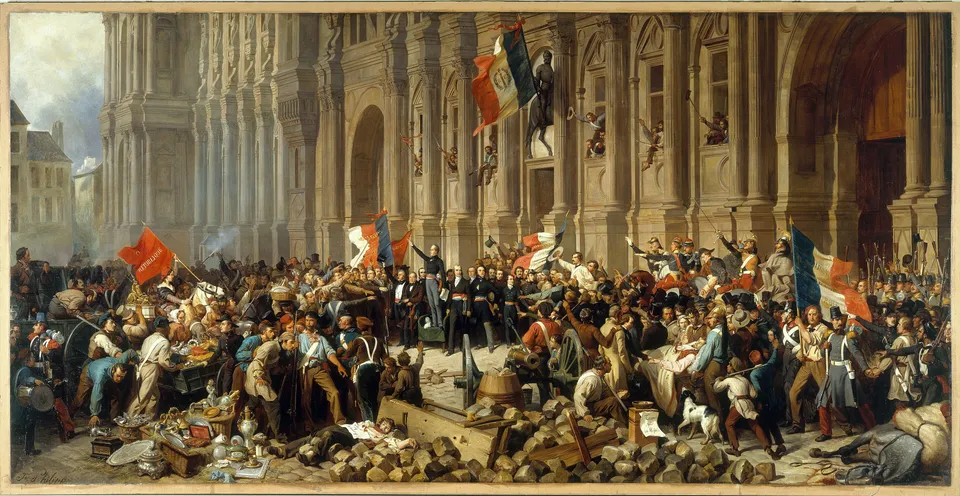
Under the July Monarchy only a tiny minority of heavy taxpayers could vote. Workers and the lesser middle class, swollen by industrialization, held “reform banquets” to demand electoral reform. When the government banned a banquet on 22 February 1848 Paris rose, and on the 24th Louis Philippe abdicated and fled to England.
The provisional government of the Second Republic included the socialist Louis Blanc and set up National Workshops for the unemployed. In April an assembly was elected by universal male suffrage. But when the conservative majority closed the workshops, the workers rose in June and were crushed (the June Days).
In the December presidential election Napoleon’s nephew Louis-Napoléon won by a landslide. He staged a coup in 1851 and the next year became emperor (Napoleon III) by plebiscite, opening the Second Empire. The February Revolution set off the March revolutions in Vienna and Berlin and brought down the Vienna system.