Culturec. 9th–8th century BC (the huts c. 8th century BC)

The Early Settlement on the Palatine Hill

Also called: Hut of Romulus, Casa Romuli, Palatine huts

Around the 9th–8th century BC an Iron Age Latin village of huts stood on the Palatine Hill beside the Tiber. Postholes of the huts survive in the rock on the south-west of the hill, and the Romans kept a “Hut of Romulus” there, rebuilding it as needed.
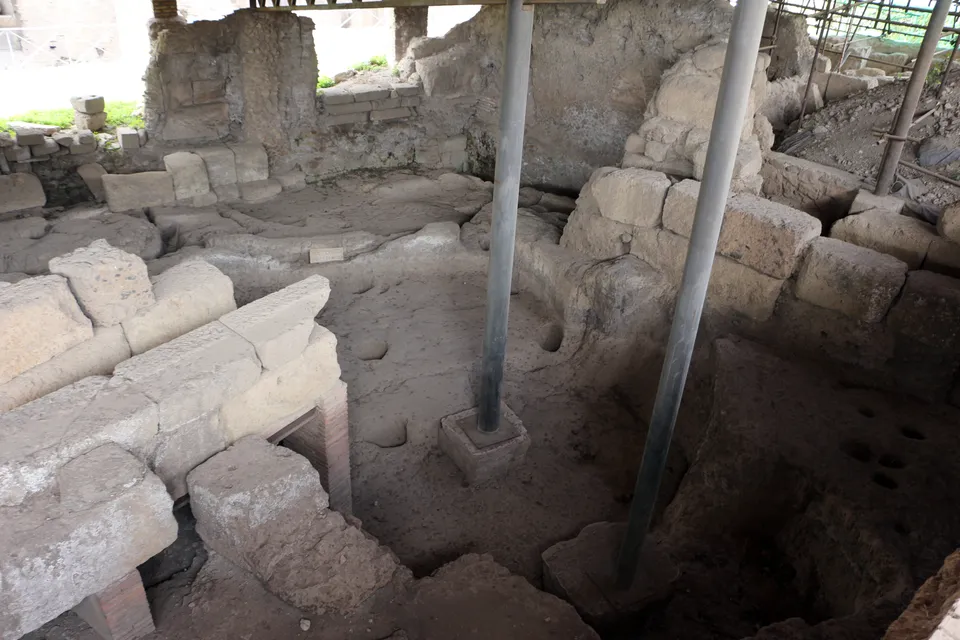
Postholes of Iron Age huts in the rock on the south-west of the Palatine Hill

Sailko · CC BY 3.0 · Source

Rome began on the hills by a shallow ford beside the Tiber Island, where the river met the route carrying salt inland from the coast. Small villages were scattered on the hilltops from about the 10th century BC, and the low ground between them (the later Forum) was a cemetery. In the tufa bedrock on the south-west of the Palatine (anciently the Germalus), excavations in 1907 and 1948 exposed postholes of huts from about the 8th century BC. The best-preserved was oblong, about 4.9 by 3.6 m, with walls of wattle and daub on wooden posts and a thatched roof. Hut-shaped cinerary urns from tombs of the same period show what they looked like.

The Romans kept a “Hut of Romulus” (Casa Romuli) on the Palatine and rebuilt it in the old style whenever it burned. Augustus built his house right beside it, presenting himself as a second Romulus. Since the 1980s the archaeologist Andrea Carandini has identified traces of a late 8th-century BC wall on the northern slope with the wall of Romulus, but this interpretation is debated.

Archaeology suggests that Rome was not founded by one man on one day but became a city as the hill villages gradually merged in the 8th–7th centuries BC. The Palatine is an archaeological park within the World Heritage Site of the historic centre of Rome (inscribed 1980).

The map in 800 BC

OpenFreeMap © OpenMapTiles © OpenStreetMap contributors

Places
Palatine Hill, Rome

3 parts of this event

  1. A Roman founding legend told in Book 1 of Livy’s History of Rome and Plutarch’s Life of Romulus. The twins Romulus and Remus, cast into the Tiber on Amulius’ orders, were suckled by a she-wolf in the Lupercal cave below the Palatine Hill and raised by the shepherd Faustulus.

  2. A Roman founding legend told in Book 1 of Livy and in Ovid’s Fasti. The twins quarrelled over the site of the new city and took the auspices from the flight of birds; when Romulus ploughed the furrow for his walls on the Palatine, Remus mocked it and leapt over, and Romulus killed him and founded Rome, named after himself. The traditional date is 21 April 753 BC.

  3. A Roman founding legend told in Book 1 of Livy and by Plutarch. Lacking wives, the men of Rome invited the neighbouring Sabines to a festival and carried off their daughters; the war that followed ended when the Sabine women, now Roman wives, rushed between the armies — and the two peoples are said to have become one.

Before and after

Themes that include this event

  • The Founding Myths of Rome1200 BC – 1471

    From Aeneas escaping burning Troy to Dido, Romulus and Remus, the Sabine women and Lucretia — the origins the Romans claimed for themselves, in story order, alongside the sites of Lavinium and the Palatine, the Aeneid and Livy’s History, the Ara Pacis and the Capitoline Wolf