Politics1st – 11th lunar month, 1894(Lunar)

Donghak Peasant Revolution

Also called: Donghak Peasant Revolution

Peasant armies led by Jeon Bong-jun rose against corrupt officials and foreign powers, triggering the First Sino-Japanese War.
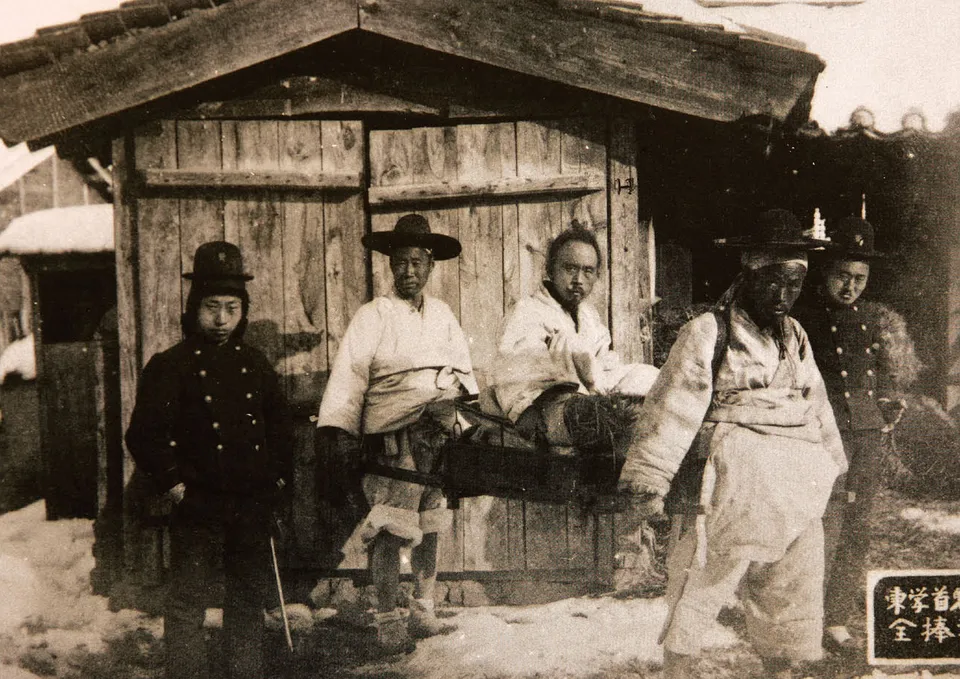
Jeon Bong-jun being taken to Seoul under arrest, February 1895

Murakami Tenshin (村上天眞) · Public domain · Source

After the ports opened, rice flowed out to Japan while local officials squeezed the peasants. Donghak followers campaigned to clear their founder’s name, and at the Boeun rally they raised the slogan “Expel the Japanese and Westerners, rise for righteousness”, turning the movement political.

It began in the 1st month with the Gobu uprising against the magistrate Jo Byeong-gap. When the investigator Yi Yong-tae persecuted the participants, Jeon Bong-jun, Son Hwa-jung and Kim Gae-nam rose again at Mujang in the 3rd month and gathered at Baeksan (the first uprising). Proclaiming “Protect the nation and secure the people” and “Drive out tyranny and save the people”, the peasant army beat government forces at Hwangtohyeon and Hwangnyongchon and took Jeonju in the 4th month. With Qing and Japanese troops arriving, it made the Jeonju truce with the government in the 5th month and set up local directorates (jipgangso) to carry out reforms.

When Japan seized Gyeongbokgung and started the Sino-Japanese War, the peasants rose again in the 9th month to drive the Japanese out (the second uprising). The southern and northern branches, the latter under Son Byong-hi, joined at Nonsan, but were crushed by government and Japanese troops at Ugeumchi near Gongju in the 11th month; Jeon Bong-jun was caught at Sunchang and executed the next year. Some of its anti-feudal demands were taken up in the Gabo Reform, and surviving fighters joined the righteous armies.

The map in 1894

OpenFreeMap © OpenMapTiles © OpenStreetMap contributors

States and rulers at the time
Joseon — Gojong

People

  • Jeon Bong-jun1855 – 1895

    leader · Leader of the Donghak peasant army, nicknamed the 'Mung Bean General'

  • Gojong1852 – 1919

    monarch · Twenty-sixth king of Joseon and first emperor of the Korean Empire

5 parts of this event

  1. 1

    Against the extortion of Gobu magistrate Jo Byeong-gap, Jeon Bong-jun led peasants to seize the county office, tear down the Manseokbo weir and share out the seized grain.

  2. 2

    Rising again at Mujang, the peasant army gathered at Baeksan, set up the Honam Righteous Army headquarters and issued its manifesto and four principles.

  3. 3

    The peasant army routed the Jeolla provincial troops at Hwangtohyeon in Jeongeup, then beat the government army from Seoul at Hwangnyongchon in Jangseong.

  4. 4

    When the peasants took Jeonju, the government called in Qing troops and Japan sent its own. In return for reform and the withdrawal of both armies, the peasants made peace with the government and withdrew.

  5. 5

    Risen again to drive out Japan, the combined Southern and Northern Donghak armies were crushed by government and Japanese troops at Ugeumchi near Gongju; Jeon Bong-jun was captured at Sunchang.

Before and after

Later
1894 Gabo Reform

Related works

  • TV drama: Nokdu FlowerDramatizedTV drama · 2019 · Shin Kyung-soo · SBS
  • TV episode: Naked Korean History Episode 25: 1894 — Why Did Jeon Bong-jun Take Up the Bamboo Spear?TV episode · 2022 · Yu Ba-da · tvN STORY

Dramatized works (films, dramas, novels) may differ from the historical record.

Themes that include this event

  • The Opening of East Asia1839 – 1901

    From the Opium War to the Boxer Protocol — sixty years in which China, Japan and Korea, forced open by Western gunboats, each tried to reform and went separate ways