Conflict17 September 1862

Battle of Antietam

Also called: Battle of Sharpsburg

McClellan’s Union army stopped Lee’s invasion of the North at Sharpsburg, Maryland; with some 23,000 casualties it was the bloodiest single day in American history.
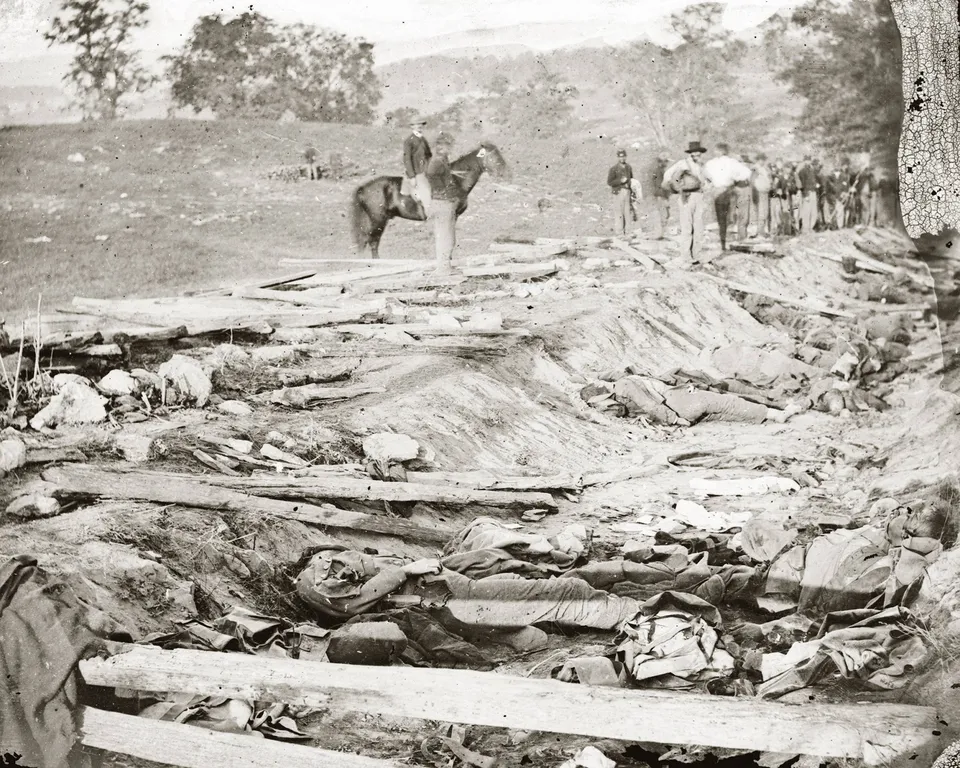
Confederate dead in the “Bloody Lane” — photograph by Alexander Gardner, September 1862, Antietam National Battlefield

Alexander Gardner · Public domain · Source

In September 1862 Robert E. Lee carried the war into Maryland for the first time. Having found a copy of Lee’s orders, George McClellan attacked him along Antietam Creek on 17 September. Fighting raged all day in the Cornfield, the sunken road called “Bloody Lane” and at Burnside’s Bridge, and casualties on both sides reached about 23,000.

The battle was inconclusive, but Lee withdrew to Virginia and McClellan did not pursue. Lincoln seized the moment to issue the preliminary Emancipation Proclamation on 22 September. In October Alexander Gardner’s photographs of the dead went on show at Mathew Brady’s New York gallery, and for the first time the public saw the bodies of a battlefield in photographs.

The map in 1862

OpenFreeMap © OpenMapTiles © OpenStreetMap contributors

States and rulers at the time
United States · belligerent — President Abraham Lincoln
Places
Antietam (Sharpsburg)

People

  • George B. McClellan1826 – 1885

    commander · Union general who built the Army of the Potomac but was overcautious; he checked Lee at Antietam and lost the 1864 election to Lincoln as the Democratic candidate

  • Robert E. Lee1807 – 1870

    commander · Confederate general who led the Army of Northern Virginia to many victories, lost at Gettysburg and surrendered at Appomattox in 1865

  • Stonewall Jackson1824 – 1863

    commander · Confederate general who earned the name “Stonewall” at First Bull Run and was mortally wounded by his own men at Chancellorsville

  • Abraham Lincoln1809 – 1865

    related figure · 16th US president (1861–1865) who preserved the Union in the Civil War and issued the Emancipation Proclamation; assassinated just after the war ended

Before and after

Earlier
1862 Battle of Shiloh

Themes that include this event

  • The American Civil War1850 – 1865

    From the Compromise of 1850 to Lincoln’s assassination — a nation divided over slavery fought four years of civil war, preserving the Union and ending slavery