Conflict6 – 7 April 1862

Battle of Shiloh

Also called: Battle of Pittsburg Landing

Confederates surprised Grant’s army camped at Pittsburg Landing on the Tennessee River, but reinforced the next day, the Union drove them back; the two days cost more than 23,000 casualties.
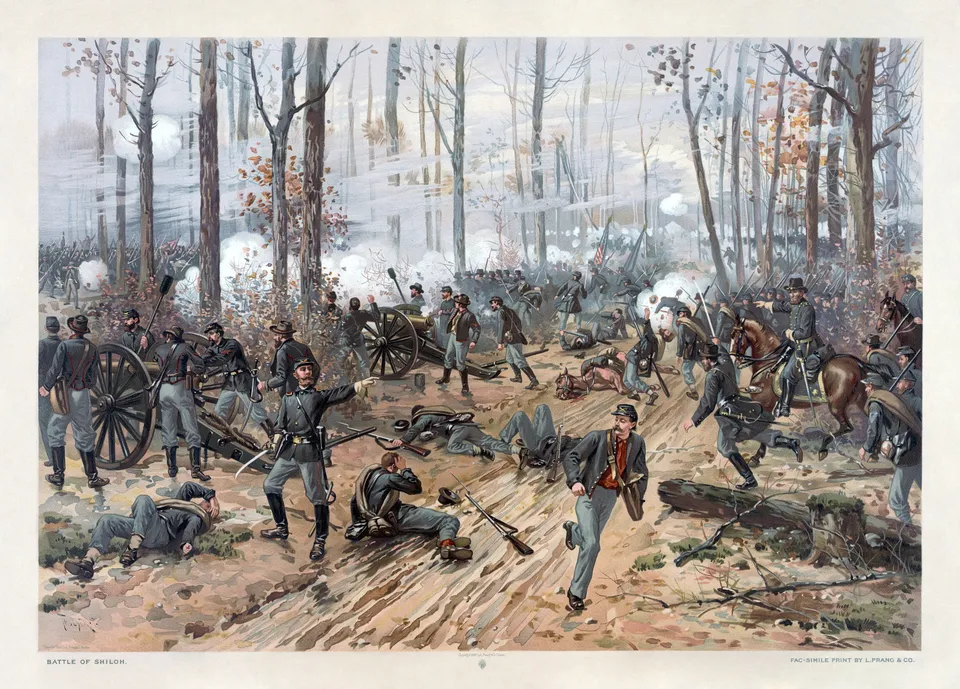
Battle of Shiloh — after Thure de Thulstrup, L. Prang & Co. chromolithograph, 1888, Library of Congress

Thure de Thulstrup / Adam Cuerden · Public domain · Source

Having taken Forts Henry and Donelson in February 1862, Ulysses S. Grant advanced south along the Tennessee River. At dawn on 6 April Albert Sidney Johnston’s Confederates surprised the Union camps near Shiloh Church and drove them back to the river; that afternoon Johnston was shot in the leg and bled to death.

When Don Carlos Buell’s reinforcements crossed the river overnight, the Union counter-attacked on 7 April and forced the Confederates, now under Beauregard, back to Corinth. Casualties on both sides came to about 23,700, more than in any American battle until then, and the nation first grasped how terrible the war would be.

The map in 1862

OpenFreeMap © OpenMapTiles © OpenStreetMap contributors

States and rulers at the time
United States · victor — President Abraham Lincoln
Places
Shiloh (Pittsburg Landing)

People

  • Ulysses S. Grant1822 – 1885

    commander · Union general who took Vicksburg, became general-in-chief in 1864 and received Lee’s surrender; 18th US president (1869–1877)

  • William T. Sherman1820 – 1891

    commander · Union general who took Atlanta in 1864 and marched across Georgia to the sea, destroying the South’s means of making war

Before and after

Themes that include this event

  • The American Civil War1850 – 1865

    From the Compromise of 1850 to Lincoln’s assassination — a nation divided over slavery fought four years of civil war, preserving the Union and ending slavery