Korea · History1948 – 195311 events

The Korean War

From the two Korean states to the armistice — the invasion, Incheon, Chinese intervention, the January Fourth Retreat and the ceasefire
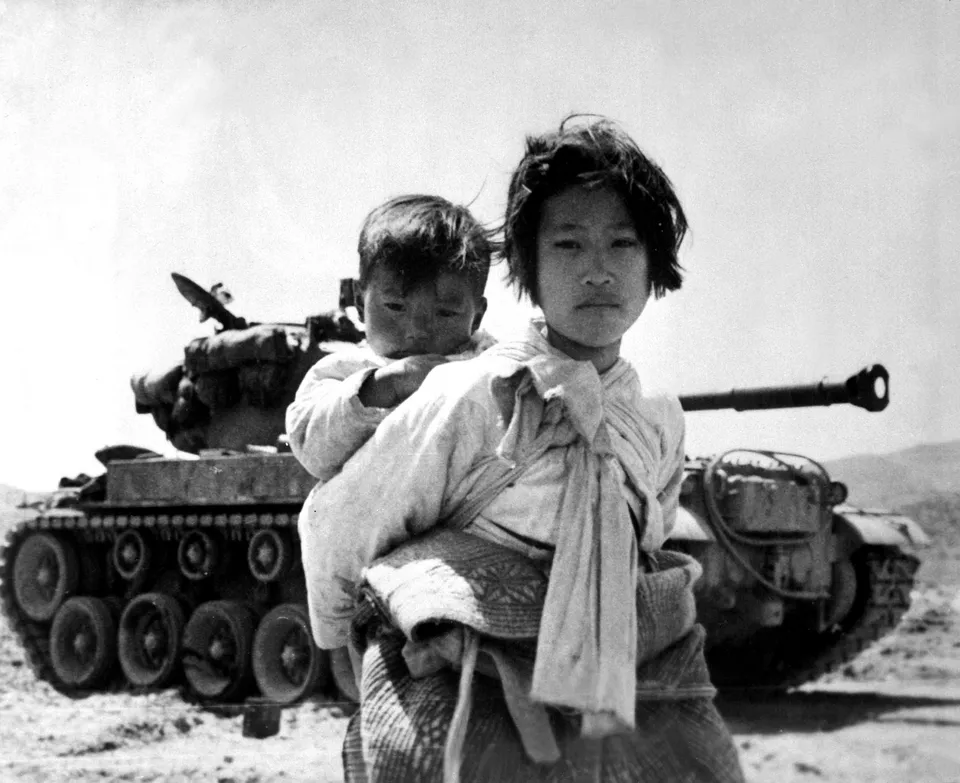
동생을 업고 멈춰 선 전차 곁을 지나는 소녀 — 행주, 1951년 6월 9일

Maj. R.V. Spencer, UAF (Navy). U.S. Army Korea - Installation Management Command. · Public domain · Source

The theme on the map

OpenFreeMap © OpenMapTiles © OpenStreetMap contributors

11 events in this theme

  1. The National Assembly elected on 10 May drew up a constitution, and on 15 August 1948 the government of the Republic of Korea was established.

  2. North of the 38th parallel, the government of the Democratic People's Republic of Korea was established with Kim Il-sung as premier.

  3. US Secretary of State Dean Acheson announced America's Pacific defense perimeter, leaving Korea and Taiwan outside it.

  4. 1950 – 1953Korean War

    A war that began with the North Korean invasion of the South at dawn on 25 June 1950. UN and Chinese forces joined, and the armistice of 27 July 1953 drew the present demarcation line.

  5. North Korean forces attacked across the whole 38th parallel, took Seoul in three days and drove south to the Nakdong River.

  6. UN forces under MacArthur landed at Incheon, cut North Korean supply lines and turned the course of the war.

  7. South Korean and UN forces retook Seoul, crossed the 38th parallel, took Pyongyang and pushed on to the Yalu River.

  8. Chinese forces crossed the Yalu and entered the war, driving South Korean and UN forces south again; the eastern front withdrew by sea from Hungnam.

  9. A Chinese offensive forced South Korean and UN forces to abandon Seoul again. After Seoul was retaken in March 1951 the front stabilized near the 38th parallel.

  10. After more than two years of talks, the armistice was signed at Panmunjom, fixing the Military Demarcation Line and the Demilitarized Zone.

  11. After the armistice, South Korea and the US signed a mutual defence treaty, the legal basis for stationing US troops in Korea.

Key people

  • Syngman Rhee1875 – 1965

    First President of the Provisional Government, who worked through diplomacy in the US; later first President of the Republic of Korea

  • Kim Il Sung1912 – 1994

    Leader of North Korea (1948–1994): chairman of the Provisional People’s Committee, then premier and president. Purged rivals after the Korean War and built one-man rule

  • Yi Si-yeong1869 – 1953

    Younger brother of Yi Hoe-yeong who went into exile with his brothers, helped found the Sinheung school, served the Provisional Government as Minister of Justice and Finance and became the first Vice President of the Republic of Korea

  • Pak Hon-yong1900 – 1956

    Communist who rebuilt the Korean Communist Party after liberation and led the South Korean Workers' Party, became vice premier and foreign minister of North Korea in 1948 and was later purged

  • Douglas MacArthur1880 – 1964

    US General of the Army; as UN commander in the Korean War he directed the Incheon landing. Relieved of command in April 1951