Treaty of Shimonoseki and Triple Intervention
Also called: Treaty of Maguan, Triple Intervention
The treaty that ended the Sino-Japanese War gave Japan Taiwan and a huge indemnity, but the Triple Intervention of Russia, Germany and France forced it to return the Liaodong Peninsula. The powers then scrambled to lease Chinese territory.
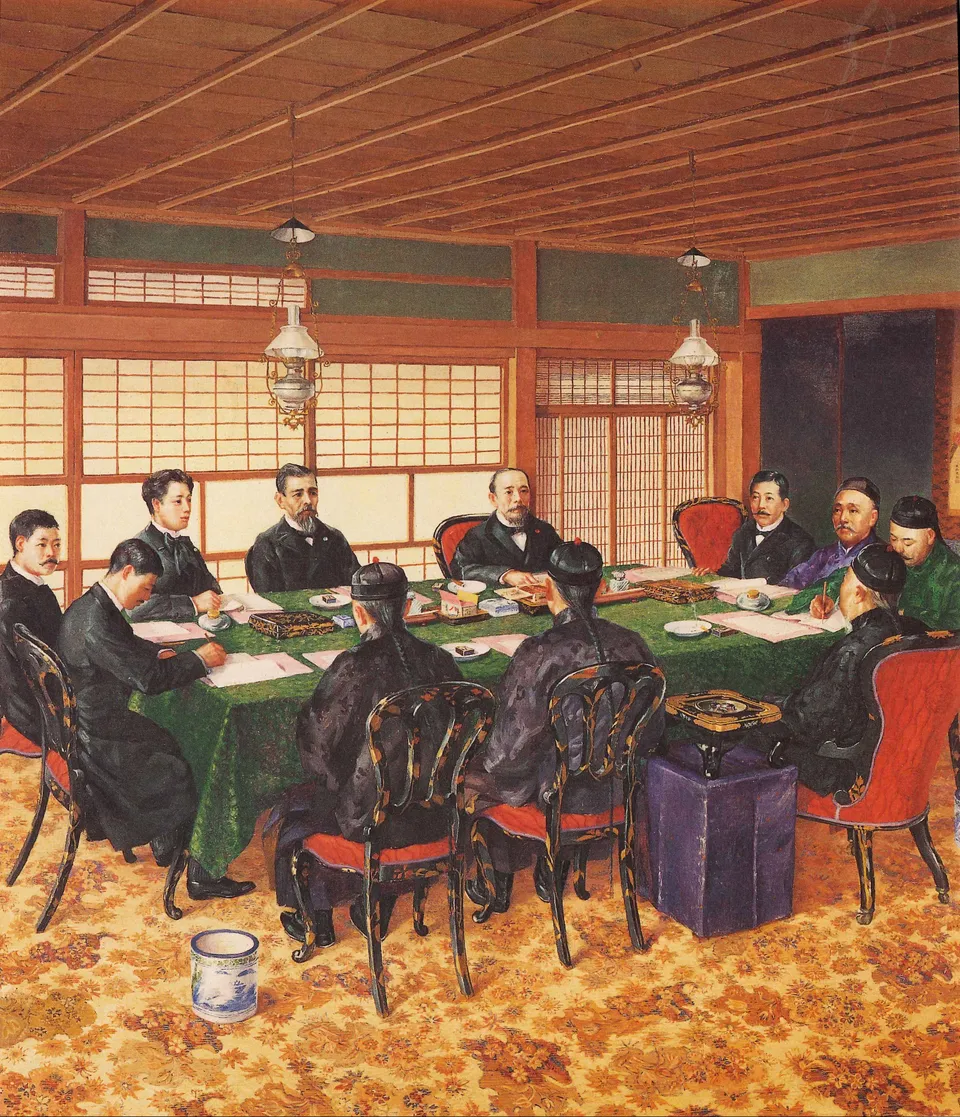
Nagatochi Hideta 永地秀太 (1873–1942) · Public domain · Source
On 17 April 1895 Li Hongzhang signed the treaty with Itō Hirobumi and Mutsu Munemitsu at the Shunpanrō inn in Shimonoseki. China recognised Korea as fully independent, ending the tributary tie; ceded the Liaodong Peninsula, Taiwan and the Penghu Islands; paid 200 million taels; opened Shashi, Chongqing, Suzhou and Hangzhou; and allowed Japanese to build factories in the treaty ports. In Taiwan residents proclaimed a Republic of Formosa to resist, but Japanese troops suppressed it.
Six days later Russia, eager to push into Manchuria, joined Germany and France in demanding the return of Liaodong (the Triple Intervention), and Japan gave it back for another 30 million taels. Vowing to "endure hardship for revenge", Japan poured the indemnity into armaments. With China’s weakness laid bare, in 1898 Germany (Jiaozhou Bay), Russia (Lüshun and Dalian), Britain (Weihaiwei and Kowloon) and France (Guangzhouwan) leased territory and carved up railway and mining rights (the scramble for concessions). In Korea the pro-Russian faction grew, setting the stage for the assassination of Empress Myeongseong.