First Sino-Japanese War
Qing and Japan fought over Korea. Victorious at Pungdo, Seonghwan, Pyongyang and the Yellow Sea, Japan ended Qing suzerainty over Korea and took Taiwan in the Treaty of Shimonoseki.
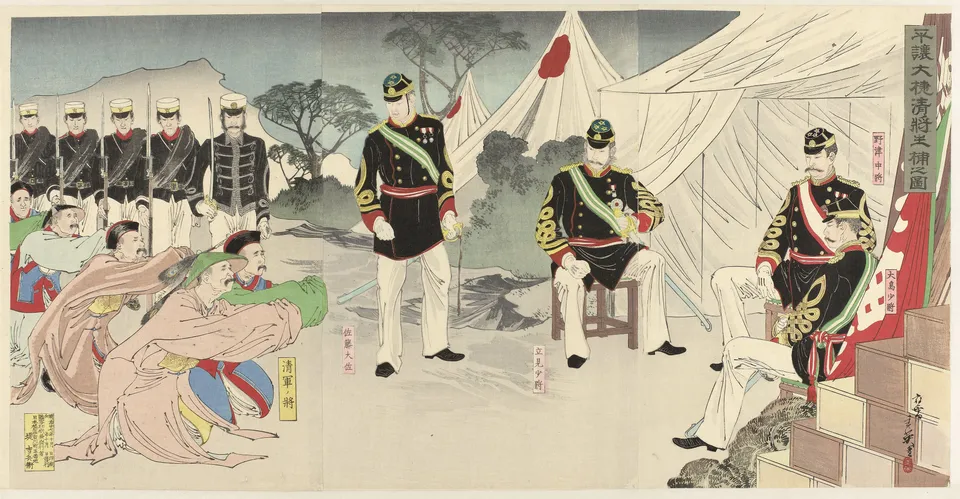
Migita Toshihide · Public domain · Source
When the Donghak peasant army took Jeonju, the Korean government asked Qing for troops; as they landed at Asan Bay, Japan sent its own to Incheon, citing the Convention of Tianjin. After the Jeonju truce Joseon asked both to withdraw, but Japan refused, demanding internal reforms, and on 23 July 1894 occupied Gyeongbokgung and installed a pro-Japanese government, which launched the Gabo Reform.
On 25 July Japan surprised the Qing fleet off Pungdo near Asan Bay, beat Qing troops at Seonghwan and declared war on 1 August. It won at Pyongyang and in the Battle of the Yellow Sea in September, then took the Liaodong Peninsula and Weihaiwei. Meanwhile the Donghak peasants’ second uprising against Japan was crushed.
By the Treaty of Shimonoseki on 17 April 1895 Qing recognised Korea as fully independent, ceded Liaodong, Taiwan and the Penghu Islands, and agreed to pay 200 million taels. But the Triple Intervention of Russia, France and Germany forced Japan to return Liaodong, and the Korean court’s turn towards Russia set the scene for the assassination of the queen.
