Battle of Mohács and the Siege of Vienna
Also called: First Siege of Vienna, Battle of Mohács
The Ottoman sultan Suleiman I destroyed the Hungarian army at Mohács and three years later besieged Habsburg Vienna. The Ottomans had driven deep into Europe and reached the height of their power.
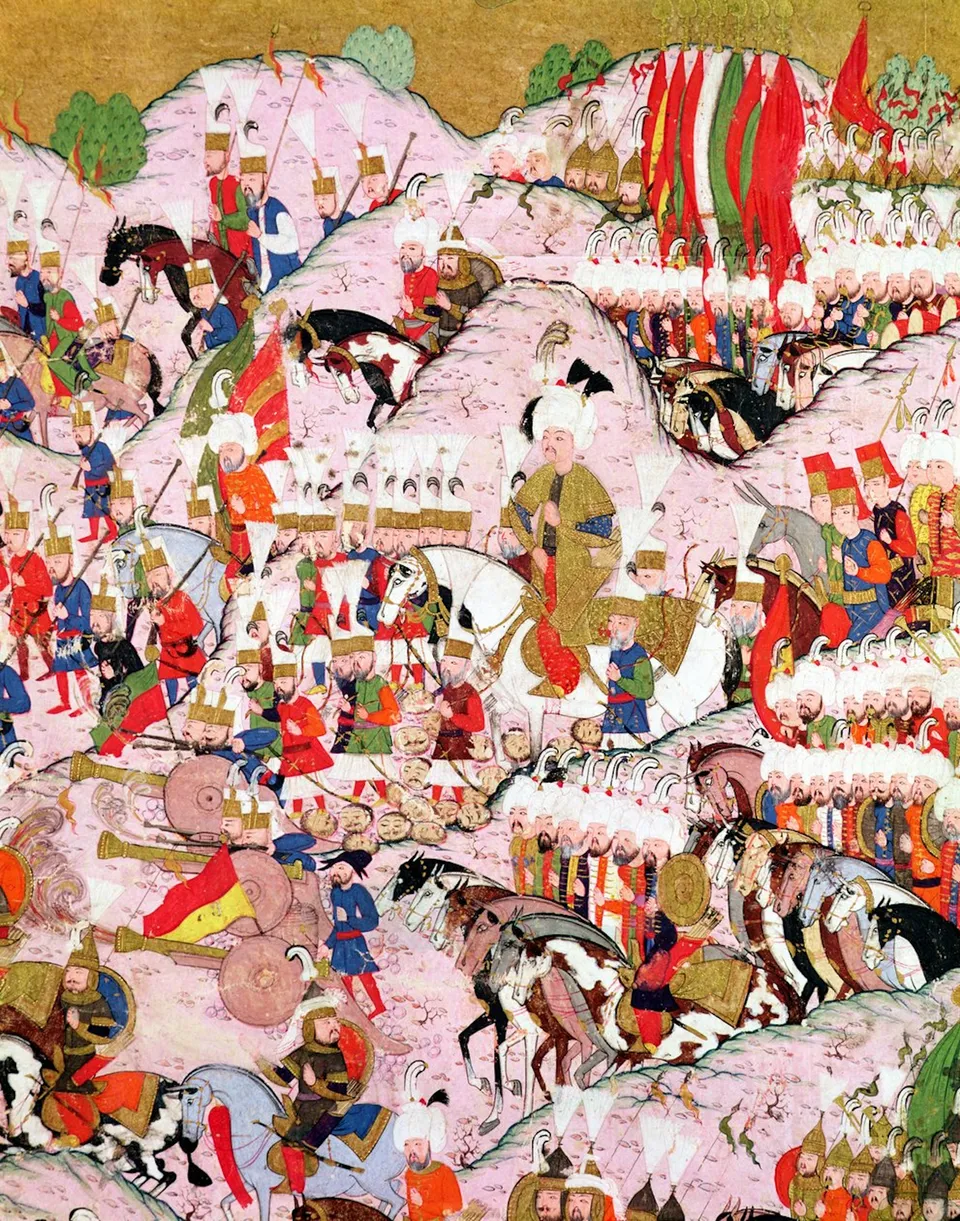
1584 · Public domain · Source
Suleiman I, who came to the throne in 1520, took Belgrade in 1521 and Rhodes in 1522. On 29 August 1526 at Mohács on the Danube the Ottomans crushed the Hungarian army in two hours, and King Louis II of Hungary died in flight. When a dispute over the Hungarian crown arose with the Habsburgs, Suleiman besieged Vienna in the autumn of 1529, but the late season and rain had kept him from bringing his heavy guns, and he withdrew in less than a month. Hungary was later divided in three.
Suleiman allied with France against the Habsburg Charles V, and Charles’s need to hold off the Ottomans kept him from crushing the German Lutherans — one reason the Reformation survived. Victory at Preveza in 1538 gave the Ottomans command of the Mediterranean, and Suleiman’s codification of the laws earned him the name Kanuni, “the Lawgiver”. The architect Sinan built the Süleymaniye Mosque in Istanbul.