Ottoman Constitution of 1876 (Midhat Constitution)
Also called: Midhat Constitution, Kanun-i Esasi, First Constitutional Era
The Ottoman constitution drafted by the reforming grand vizier Midhat Pasha was proclaimed and a parliament met. But the sultan soon suspended both, using the Russo-Turkish War as a pretext.
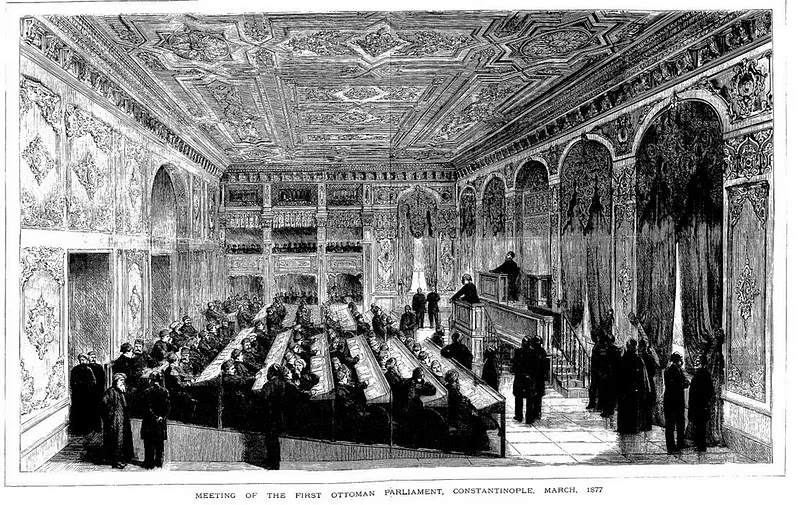
The Graphic · Public domain · Source
When bankruptcy and Balkan uprisings continued after the Tanzimat, the Young Ottomans and Midhat Pasha, who wanted constitutional government, replaced the sultan in 1876. The new sultan, Abdulhamid II, proclaimed a constitution on 23 December 1876. It was the first modern constitution in the Islamic world, establishing a two-chamber parliament and the equality of subjects; the first parliament met in March 1877.
Yet the constitution left the sultan great power. Abdulhamid II exiled Midhat and, in February 1878, during the Russo-Turkish War, dissolved parliament and suspended the constitution. For the next thirty years he ruled as an autocrat, trying to hold the empire together with Pan-Islamism. The constitution was restored only by the Young Turk Revolution of 1908.