Conflict24 April 1877 – 3 March 1878 (war) · 13 June – 13 July 1878 (Congress of Berlin)

Russo-Turkish War and the Congress of Berlin

Also called: Congress of Berlin, Treaty of San Stefano

Russia defeated the Ottoman Empire in the name of the Balkan Slavs, but at the Congress of Berlin, called because Britain and Austria objected, its southward advance was checked again.
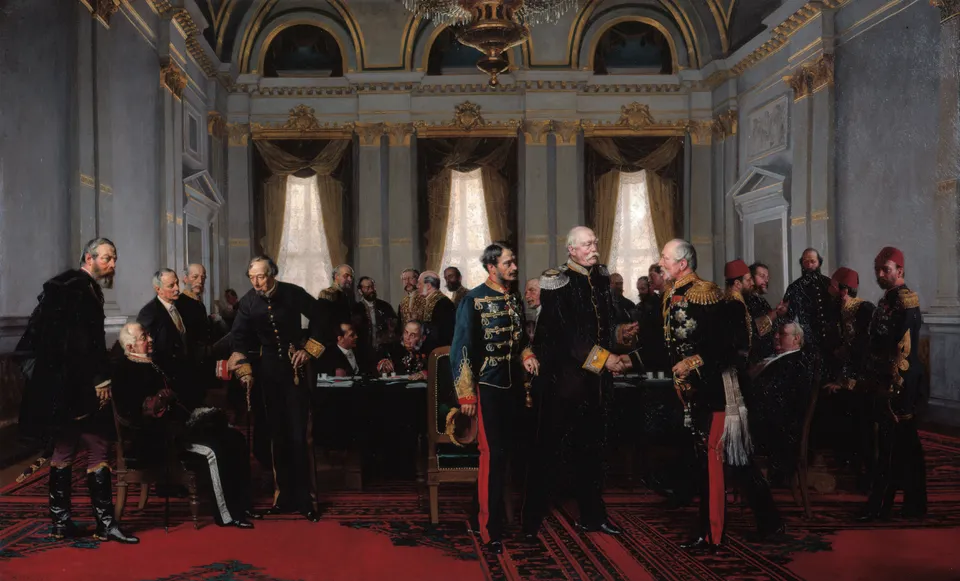
The Congress of Berlin, 13 July 1878; Bismarck shakes hands at the centre (Anton von Werner, 1892)

Anton von Werner · Public domain · Source

When the Ottomans brutally crushed the Bulgarian uprising of 1876, Russia, championing Pan-Slavism, declared war on 24 April 1877. After the siege of Plevna the Russian army crossed the Balkan Mountains and approached Istanbul, and the Treaty of San Stefano of March 1878 created a large "Greater Bulgaria" under Russian influence.

Britain and Austria, unwilling to see Russia reach the Mediterranean, objected, and Germany’s Bismarck, posing as an "honest broker", hosted the Congress of Berlin in June–July 1878. Serbia, Montenegro and Romania won recognition of their independence, but Bulgaria was cut down to a small autonomous principality; Austria gained the right to administer Bosnia-Herzegovina, and Britain took Cyprus.

Blocked in the Balkans, Russia turned to Central and East Asia, and its rivalry with Britain (the Great Game) stretched from Afghanistan to the Geomundo incident in Korea (1885). The Balkans, where Pan-Slavism collided with Pan-Germanism, became the "powder keg of Europe".

The map in 1877

OpenFreeMap © OpenMapTiles © OpenStreetMap contributors

States at the time
Russia · victor
Ottoman Empire · defeated
Romania · independence
Bulgaria · established
Germany · host
Great Britain
Austria-Hungary
British Cyprus · established
Places
Berlin

People

  • Otto von Bismarck1815 – 1898

    diplomat · Minister-president of Prussia (1862–1890) and first chancellor of the German Empire (1871–1890) who unified Germany through three wars by his policy of “blood and iron”

  • Alexander II of Russia1818 – 1881

    monarch · Emperor of Russia (1855–1881) who, after defeat in the Crimean War, emancipated the serfs and pursued reform from above, but was assassinated by revolutionaries

  • Abdulhamid II1842 – 1918

    monarch · Ottoman sultan (1876–1909) who granted a constitution, soon suspended it and ruled as an autocrat for thirty years

Before and after

Themes that include this event

  • Imperialism and the Partition of the World1839 – 1914

    From the Tanzimat to Sarajevo — seventy-five years in which the powers carved up West Asia, India, Southeast Asia, Africa and the Pacific, and the peoples there answered with reform and resistance