Hitler’s Rise to Power and the Enabling Act
Also called: Machtergreifung, Enabling Act of 1933, Reichstag fire
Hitler, whose Nazi Party had become the largest in the Reichstag during the Depression, was made chancellor and used the Enabling Act, which handed lawmaking power to the government, to build a one-party dictatorship. The Weimar Republic collapsed.
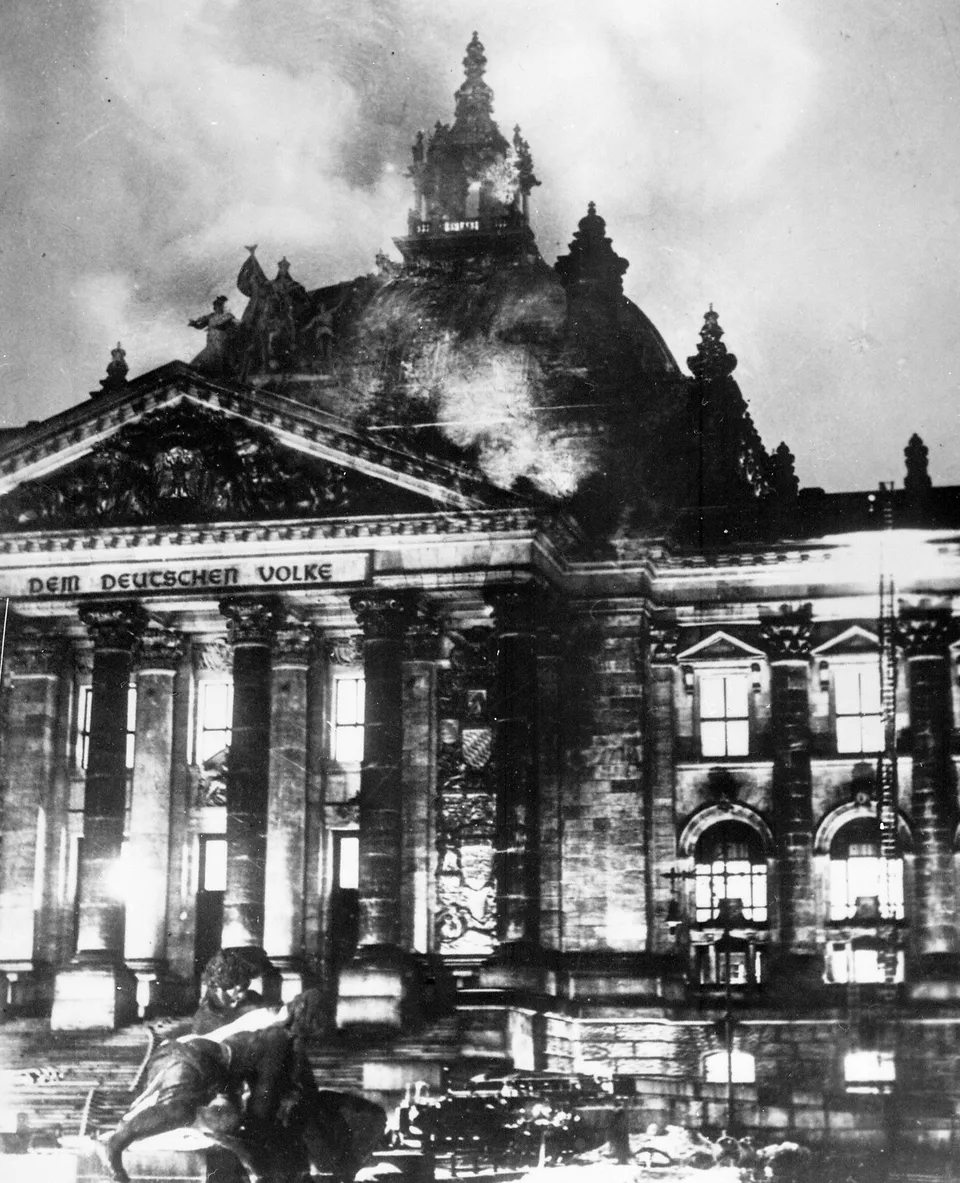
Unknown author · Public domain · Source
The Nazi Party (National Socialist German Workers’ Party) stood for scrapping the Treaty of Versailles, antisemitism, anti-communism and “living space”. After the failed Munich putsch of 1923 it sought power through elections, and as unemployment soared in the Depression it won 18 per cent of the vote in 1930 and 37 per cent in July 1932, becoming the largest party. Urged on by conservatives who believed they could control him, President Hindenburg appointed Hitler chancellor on 30 January 1933.
When the Reichstag building burned on 27 February, Hitler blamed the Communists, suspended basic rights by emergency decree and had Communists arrested. On 23 March the Reichstag passed, by 444 votes to 94, the Enabling Act allowing the government to make laws without parliament; only the Social Democrats voted against.
The Nazis dissolved the trade unions and in July banned all other parties, and when Hindenburg died in 1934 Hitler combined the offices of president and chancellor as Führer. Opponents were crushed by the secret police (Gestapo) and concentration camps; Germany left the League of Nations in 1933 and rearmed, reintroducing conscription in 1935.