Locarno Treaties
Also called: Locarno Pact, Spirit of Locarno
Germany, France and Belgium agreed to respect each other’s borders, with Britain and Italy as guarantors. Germany joined the League of Nations the next year as a spirit of international cooperation took hold.
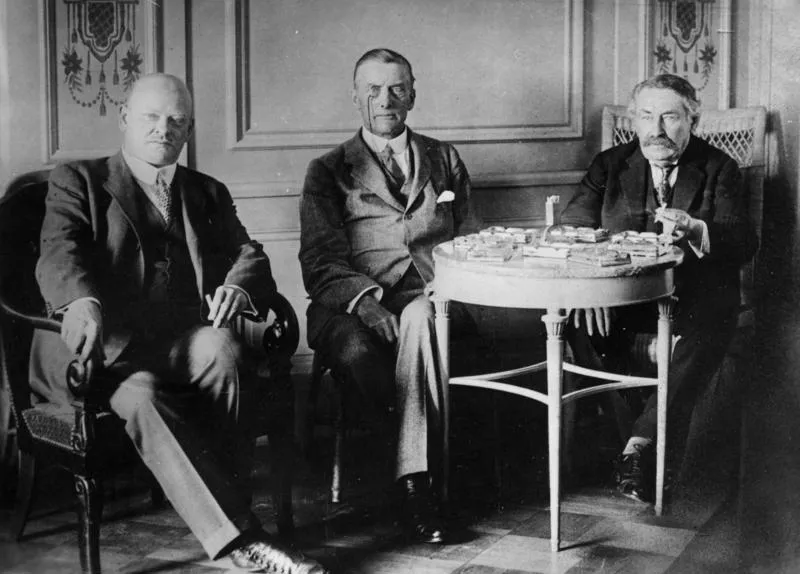
Unknown author · CC BY-SA 3.0 de · Source
After the Ruhr crisis German foreign minister Stresemann chose to comply with Versailles while regaining Germany’s standing through negotiation. In October 1925 delegates of Germany, France, Belgium, Britain, Italy, Poland and Czechoslovakia met at Locarno in Switzerland and agreed on seven treaties, signed in London on 1 December.
In the central Rhineland Pact Germany freely accepted its western borders with France and Belgium and the demilitarization of the Rhineland, guaranteed by Britain and Italy. Its eastern borders with Poland and Czechoslovakia, however, were covered only by arbitration treaties and remained a source of trouble. Germany became a permanent member of the League Council in 1926, and Stresemann and France’s Briand received the Nobel Peace Prize. The “spirit of Locarno” led on to the Kellogg–Briand Pact, but was broken by Hitler’s remilitarization of the Rhineland in 1936.