Proclamation of the Korean Empire
Back at Gyeongungung, Gojong ascended as emperor at the Hwangudan altar, renaming the country the Korean Empire with the era name Gwangmu.
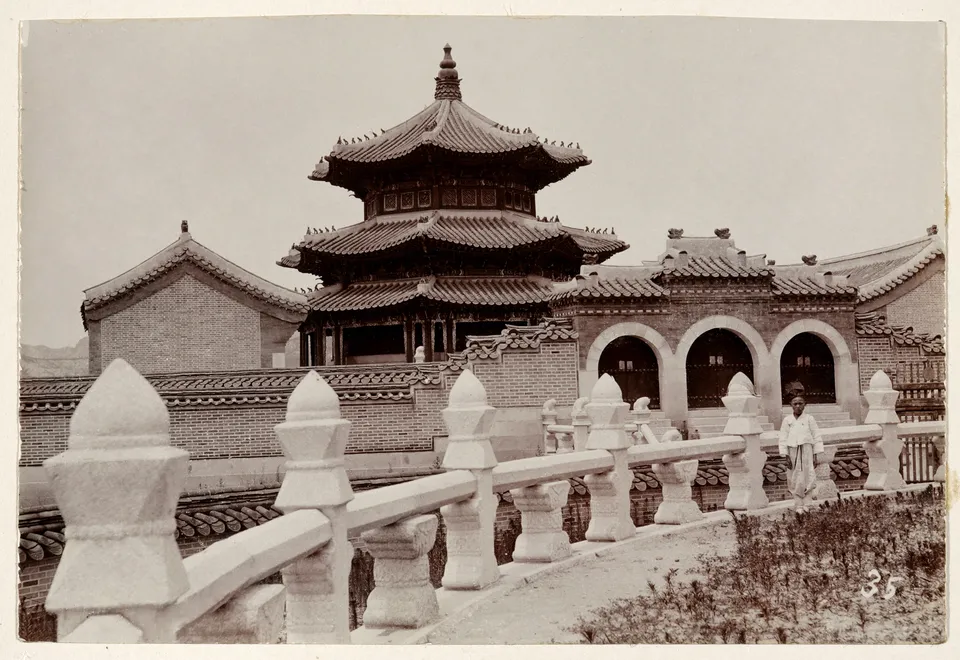
Sander, Hermann Gustav Theodor · Public domain · Source
Amid calls to assert the country’s independence after his stay at the Russian legation, Gojong returned to Gyeongungung (Deoksugung) in February 1897. In August he adopted the era name Gwangmu and, at the urging of scholars and officials, held his enthronement as emperor at the Hwangudan altar in October, signalling to the world that Korea was a sovereign state.
The Constitution of the Korean Empire of 1899 declared it an independent absolute monarchy whose emperor held supreme command, legislative, judicial and all other powers. Under the slogan of “old ways as the foundation, new ways as reference”, the Gwangmu Reform resurveyed land and issued title deeds (jigye), set up a Supreme Military Council to put the army under the emperor, and promoted commerce, industry and vocational schools.
Meanwhile the Independence Club, which had called for a parliament, was dissolved in 1898. Reforms that put strengthening the throne first were cut short by the Russo-Japanese War and Japanese aggression.
