Politics30 May 1854

Kansas–Nebraska Act

Also called: Bleeding Kansas

By leaving slavery in the Kansas and Nebraska territories to their settlers, the act erased the Missouri Compromise line; bloodshed followed in Kansas and the Republican Party was born to oppose the spread of slavery.
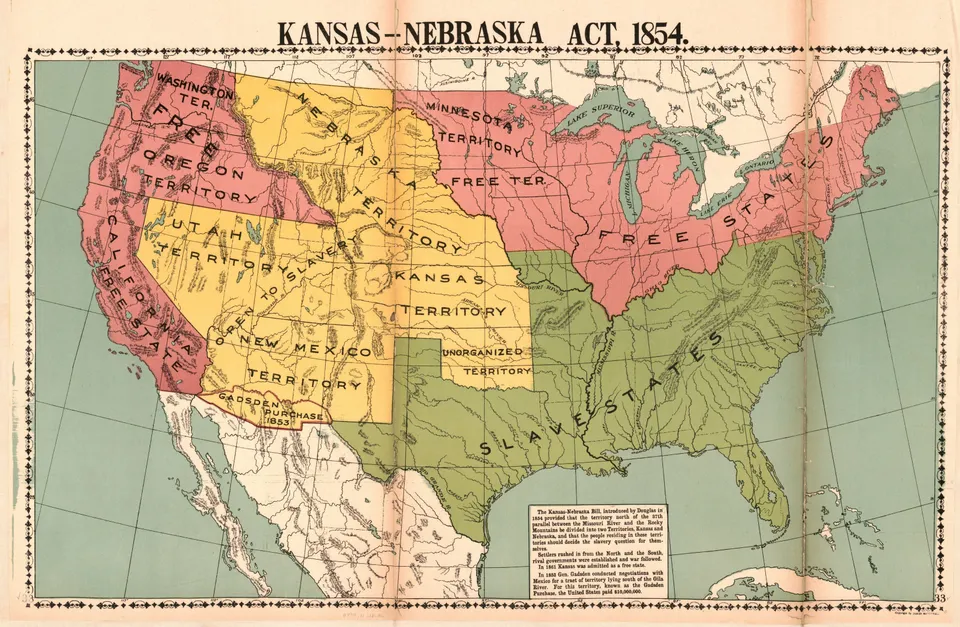
Free states, slave states and territories after the Kansas–Nebraska Act (1854) — McConnell’s historical map, 1919, Library of Congress

McConnell Map Co. · Public domain · Source

Stephen Douglas wanted to organise territories on the western plains for a transcontinental railroad, and to win Southern votes he wrote in popular sovereignty, leaving slavery to a vote of the settlers. Signed by President Pierce on 30 May 1854, the act in effect repealed the Missouri Compromise (1820), which had barred slavery north of 36°30′.

Pro- and anti-slavery settlers poured into Kansas, set up rival legislatures and attacked each other. When pro-slavery men sacked Lawrence in May 1856, John Brown killed five pro-slavery settlers at Pottawatomie. Dozens died in what became known as “Bleeding Kansas”. Opponents of the act founded the Republican Party in 1854, and the Whig Party collapsed.

The map in 1854

OpenFreeMap © OpenMapTiles © OpenStreetMap contributors

States and rulers at the time
United States — President Franklin Pierce
Places
Lawrence, Kansas

People

  • Stephen A. Douglas1813 – 1861

    key figure · Democratic senator from Illinois who championed popular sovereignty, wrote the Kansas–Nebraska Act and lost the 1860 election to Lincoln

  • John Brown1800 – 1859

    related figure · Abolitionist who advocated armed struggle; he fought in Kansas and in 1859 raided the Harpers Ferry armory, for which he was hanged

Before and after

Themes that include this event

  • The American Civil War1850 – 1865

    From the Compromise of 1850 to Lincoln’s assassination — a nation divided over slavery fought four years of civil war, preserving the Union and ending slavery