Unification of Italy
Also called: Risorgimento, Expedition of the Thousand, Redshirts
Cavour of the Kingdom of Sardinia joined the north and centre through diplomacy and war, and Garibaldi brought in the south; the Kingdom of Italy was proclaimed in 1861. Venice was added in 1866 and Rome in 1870, completing unification.
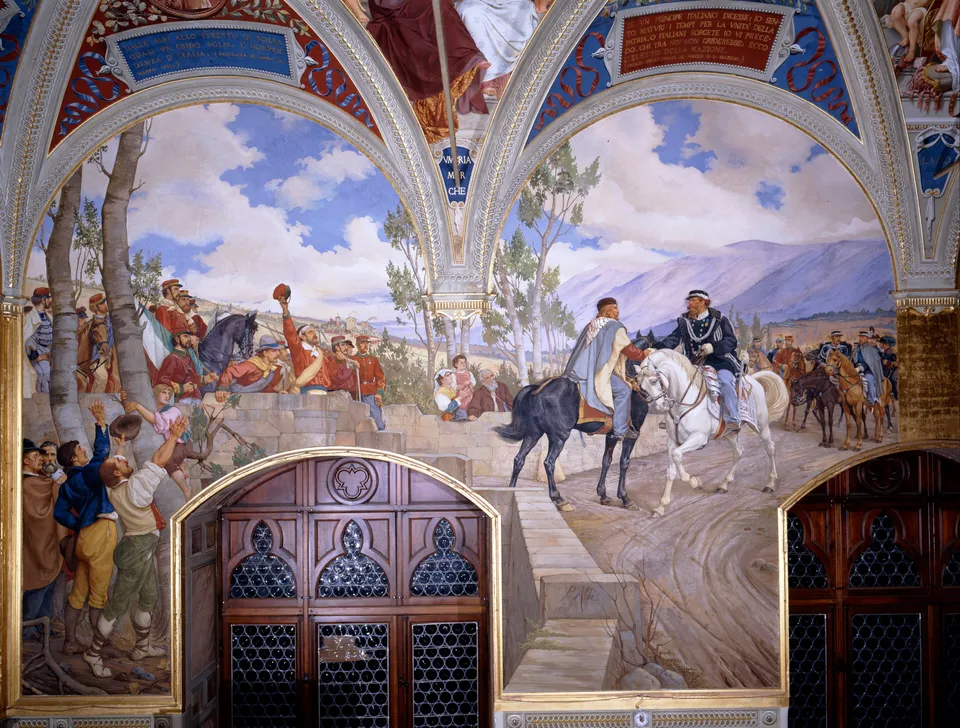
Pietro Aldi (1852 - 1888) – painter (Italian) Born in Manciano (Grosseto). Died in Manciano (Grosseto). Details on Google Art Project · Public domain · Source
After the Congress of Vienna Italy was divided into several states, with the north under Austrian rule. When Mazzini’s Young Italy, the Carbonari revolts and the revolutions of 1848 all failed, leadership of the national cause passed to the Kingdom of Sardinia, a constitutional monarchy ruled by Italians. Its prime minister Cavour modernized the kingdom, building railways, and raised its standing by joining the Crimean War.
Allied with Napoleon III, Cavour fought Austria in 1859 and won Lombardy; in 1860 plebiscites joined central Italy to Sardinia in exchange for ceding Savoy and Nice to France. The same year Garibaldi led the Thousand, the “Redshirts”, to conquer Sicily and Naples and handed them to the King of Sardinia. In March 1861 the Kingdom of Italy was proclaimed with Victor Emmanuel II as king.
Siding with Prussia in the Austro-Prussian War, Italy gained Venetia in 1866, and in 1870, when French troops left during the Franco-Prussian War, it seized Rome from the Papal States and made it the capital the following year. “Unredeemed Italy” — Trentino and Trieste — remained Austrian, a source of later conflict.