March on Rome
Also called: Marcia su Roma, Fascism
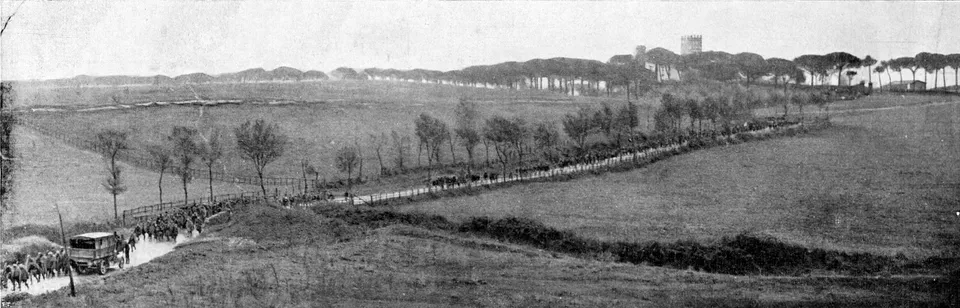
As Mussolini’s Fascists (the Blackshirts) converged on Rome, the king made Mussolini prime minister. Italy had the first Fascist government.
Unknown author · Public domain · Source
Italy was among the victors, yet it failed to gain all the land it wanted, and resentment of a “mutilated victory” ran deep while postwar inflation and factory occupations shook society. Mussolini founded the Fasci di Combattimento in Milan in 1919 and built them into the National Fascist Party in 1921. His Blackshirts attacked socialists and trade unions with violence, winning support from landowners, industrialists and a middle class afraid of communism.
On 28 October 1922 tens of thousands of Fascists marched on Rome. King Victor Emmanuel III refused to sign a decree of martial law and the next day asked Mussolini to form a government. After the murder in 1924 of the socialist deputy Matteotti, a critic of the regime, Mussolini abolished the other parties and the free press to build a one-party dictatorship, and in 1929 he made peace with the papacy in the Lateran Treaty.
Fascism was a totalitarianism that set nation and state above the individual, rejected both parliamentary democracy and communism, and exalted the leader and expansion abroad. The Italian model inspired far-right movements in many countries, above all the German Nazis.