Babur Founds the Mughal Empire
Also called: First Battle of Panipat, Founding of the Mughal Empire
Babur, a descendant of Timur, defeated Ibrahim Lodi of the Delhi Sultanate at the Battle of Panipat and founded the Mughal Empire.
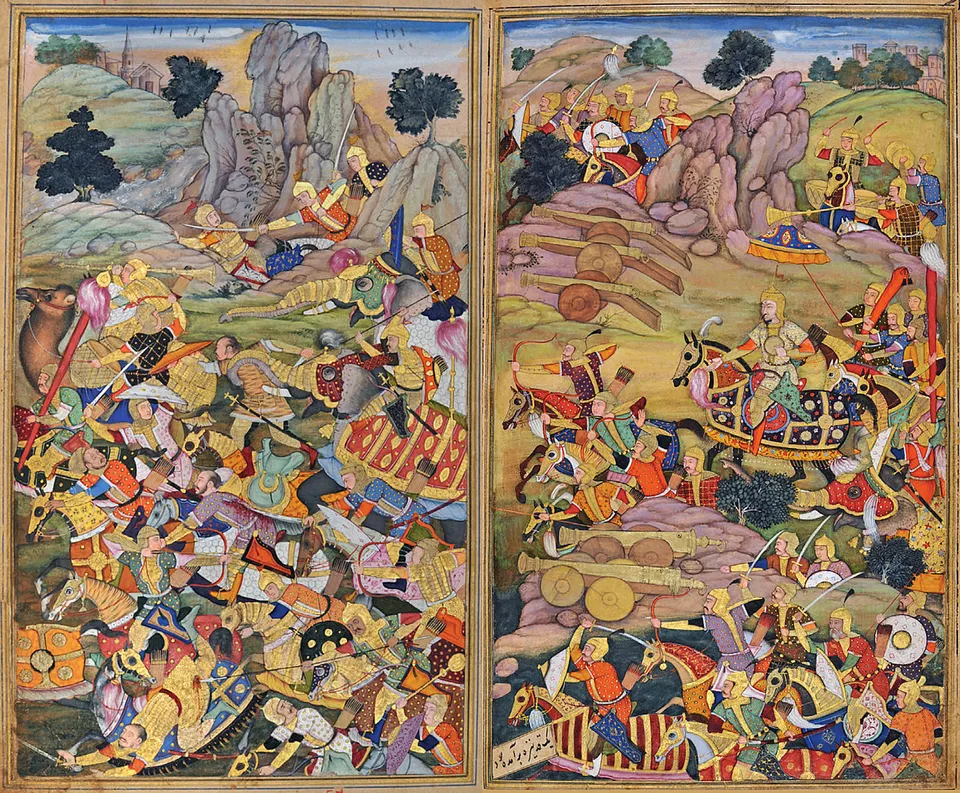
1598 artist · Public domain · Source
Babur descended from Timur on his father’s side and from Genghis Khan on his mother’s. A minor ruler of Ferghana in Central Asia, he was pushed out by the Uzbeks and failed to hold Samarkand; after taking Kabul in 1504 he turned to India. On 21 April 1526 at Panipat, north of Delhi, he drew up his army behind a line of linked carts, fired cannon and muskets and enveloped the flanks with cavalry, defeating Ibrahim Lodi’s far larger army. Ibrahim was killed, and the Delhi Sultanate came to an end.
Babur took Delhi and Agra and the next year beat a Rajput coalition at Khanwa, winning northern India. Mughal means “Mongol” in Persian. He left a memoir in Turkic, the Baburnama. After his death in 1530 his son Humayun was driven out for a time before returning, and his grandson Akbar united most of northern India and gave the empire its framework. In the Mughal Empire Persian-Islamic and Indian cultures blended.