Congress of Vienna and the Vienna System
Also called: Vienna system, Concert of Europe, Holy Alliance
After the Napoleonic Wars the European powers met in Vienna and agreed to restore the pre-revolutionary order. The conservative system led by Metternich (the Vienna system) suppressed liberal and nationalist movements.
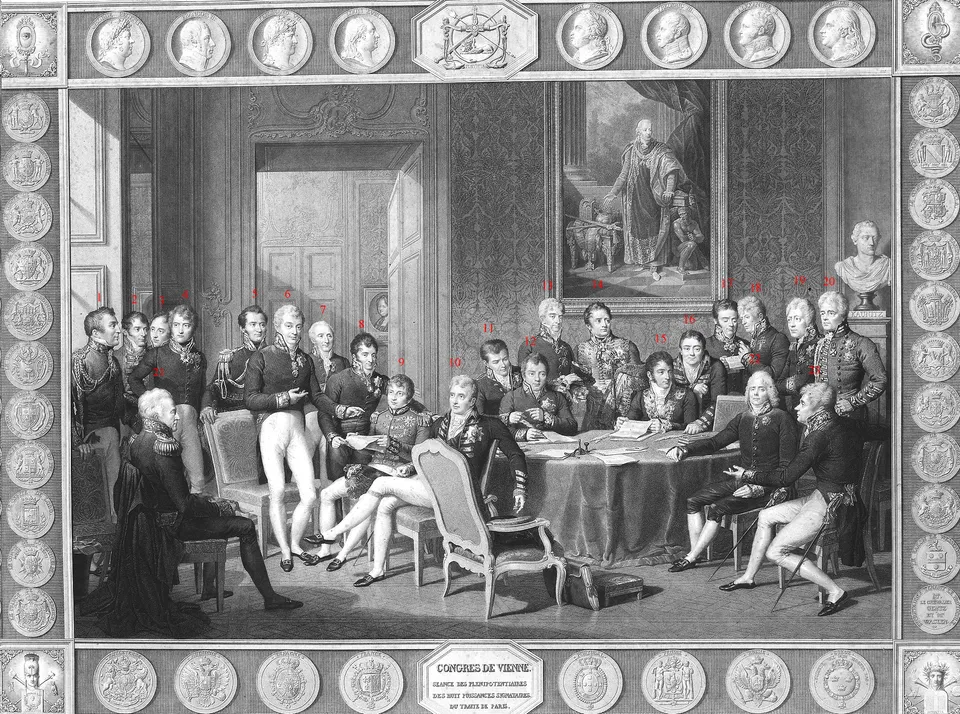
After Jean-Baptiste Isabey · CC BY-SA 3.0 · Source
From September 1814 delegates from across Europe gathered in Vienna under the lead of the Austrian statesman Metternich. The congress took as its principles legitimacy — restoring the dynasties and borders from before the Revolution — and a balance of power among the great states. Conflicting interests dragged out the talks, giving rise to the quip “the Congress dances, but does not progress”. The Final Act was signed in June 1815.
The Bourbons returned to France (Louis XVIII). Russia gained most of Poland, Prussia the Rhineland and part of Saxony, Austria Lombardy–Venetia, and Britain Malta, the Cape Colony and Ceylon. A German Confederation of 39 states was created, Belgium was joined to the Netherlands and Switzerland became permanently neutral. The wishes of nations were ignored.
The Holy Alliance proposed by Alexander I and the Quadruple Alliance of Britain, Russia, Austria and Prussia (later the Quintuple Alliance with France) upheld this order. They suppressed the German student Burschenschaften and revolutions in Spain and Italy, but the system was shaken by Greek independence and the July Revolution of 1830 and collapsed when the revolutions of 1848 drove out Metternich.