Building of Azuchi Castle
Also called: Azuchi-jō
Oda Nobunaga built Azuchi Castle, with its towering keep, on Mount Azuchi by Lake Biwa. It was the first of the early modern castles with stone walls and a keep, and the symbol of Nobunaga’s regime.
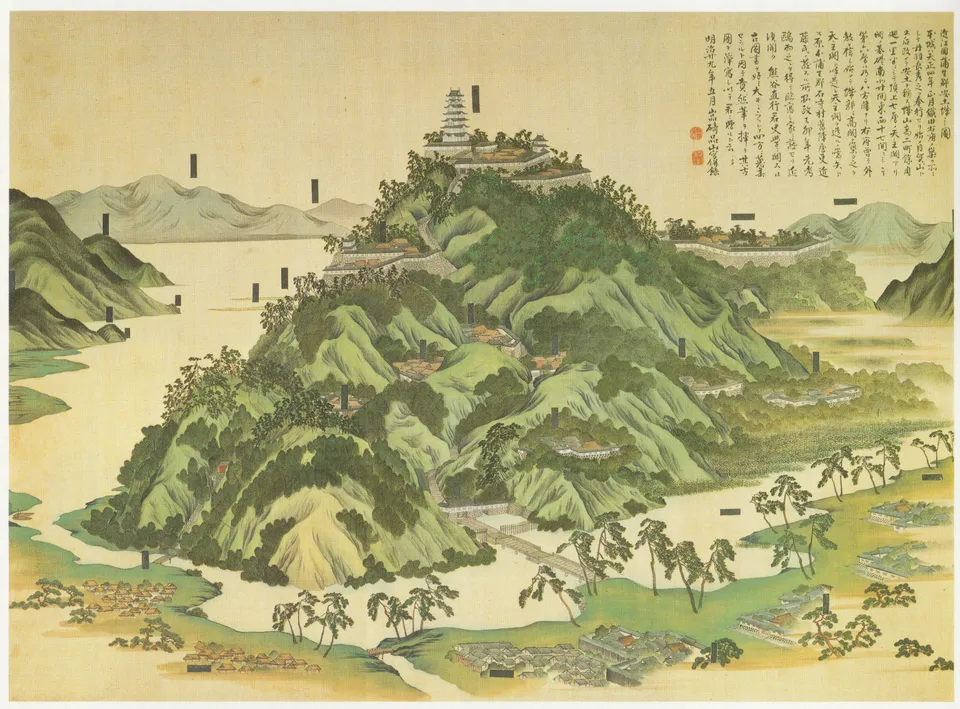
Iwasaki Ōu 岩崎鴎雨 · Public domain · Source
In 1576 Nobunaga began building a castle on Mount Azuchi in Ōmi, on the route linking Kyoto with the east and Hokuriku, and in 1579 completed its keep (tenshu) of five outer roofs and seven floors. Raised on high stone walls and decorated with gold leaf and the wall paintings of Kanō Eitoku, it became the model for later Japanese castles. Below it he opened a castle town with free markets and guilds (rakuichi rakuza), and a Jesuit seminary was built there.
Nobunaga sent a painted screen of Azuchi to Pope Gregory XIII with the Tenshō embassy, but it is lost. Just after the Honnōji Incident of 1582 the keep and main enclosure burned; who set the fire is uncertain. Only the stone walls and foundations remain, now a Special Historic Site. The age of Nobunaga and Hideyoshi is named the Azuchi–Momoyama period after this castle and Hideyoshi’s Fushimi (Momoyama).