Conflict636 – 651

Fall of the Sasanian Empire and the Muslim Conquest of Western Asia

Also called: Battle of al-Qadisiyyah, Battle of Nahavand, Muslim conquest of Persia

Arab armies defeated the Sasanians at Qadisiyya (636) and Nahavand (642), and with the death of the last king, Yazdegerd III, in 651 Sasanian Persia came to an end.
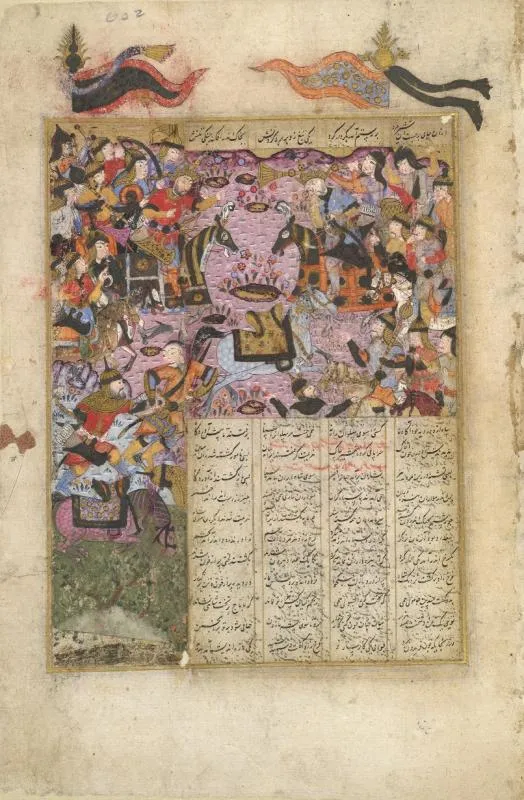
The Battle of al-Qadisiyyah in a 1614 manuscript of the Persian epic Shahnameh (British Library)

Unknown author · Public domain · Source

Sasanian Persia and the Byzantine Empire had fought each other into exhaustion by the early 7th century. In 636 the Arabs defeated the Byzantines on the Yarmuk River in Syria and the Sasanians at Qadisiyya in Iraq. The Sasanian capital Ctesiphon fell the next year, and after defeat at Nahavand in 642 the dynasty never recovered. Fleeing east, Yazdegerd III was killed near Merv in 651, ending a dynasty of more than four hundred years; his son Peroz took refuge at the Tang court and sought its help.

Iran became Muslim only slowly over several centuries, and some Zoroastrians moved to India (the Parsis). Persian bureaucracy, court culture and learning later flowed deeply into the Islamic civilisation of the Abbasids. The Muslim world now spanned western Asia and Egypt.

The map in AD 636

OpenFreeMap © OpenMapTiles © OpenStreetMap contributors

States at the time
Rashidun Caliphate · conqueror
Sasanian Empire · fell
Byzantine Empire · invaded

People

  • UmarAD 584 – AD 644

    monarch · Second caliph (634–644), whose armies conquered Syria, Egypt, Iraq and Persia, and who fixed the Islamic calendar from the year of the Hijra

  • UthmanAD 576 – AD 656

    monarch · Third caliph (644–656), of the Umayyad clan, who had the standard text of the Qur’an compiled; resented for favouring his kin, he was killed by rebels in Medina

  • Yazdegerd IIIAD 651

    monarch · Last king of Sasanian Persia (632–651), who fled east after a string of defeats by the Arabs and was killed near Merv, ending the dynasty

Themes that include this event

  • The Rise of the Islamic WorldAD 570 – 1055

    From the revelation to Muhammad to the Seljuk entry into Baghdad — 450 years in which a new faith from Arabia built a civilisation stretching from Iberia to Central Asia and reached as far as Silla by sea