World historyAD 184 – AD 28021 events
The Three Kingdoms
From the Yellow Turban Rebellion to the Jin reunification — a century of Wei, Shu and Wu, the age of Cao Cao, Liu Bei and Sun Quan
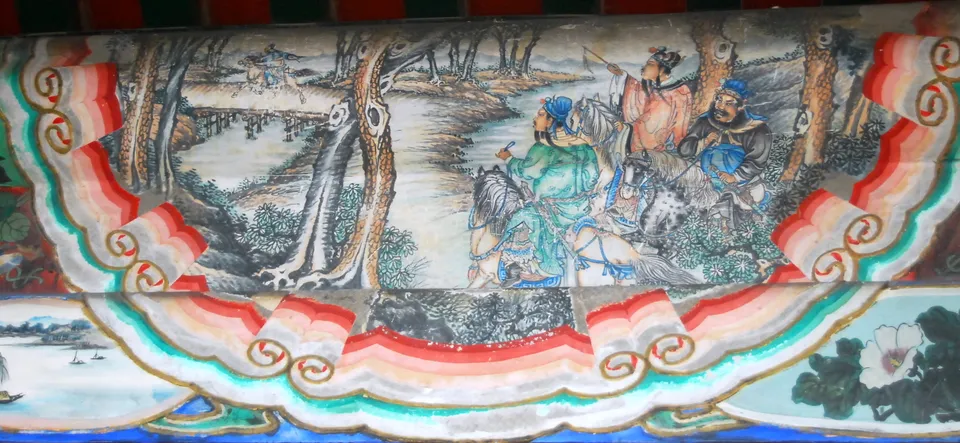
shi zhao · Public domain · Source
From the Yellow Turban Rebellion to the Jin reunification — a century of Wei, Shu and Wu, the age of Cao Cao, Liu Bei and Sun Quan
shi zhao · Public domain · Source
Zhang Jue of the Way of Great Peace led peasants wearing yellow headbands in revolt against the Eastern Han. The rising was crushed within the year, but the local forces raised to fight it grew into warlord armies, opening the Three Kingdoms era.
The warlord Dong Zhuo entered Luoyang, replaced the emperor and took over the court. When the eastern lords raised a coalition against him, he burned Luoyang and moved the capital to Chang’an.
Cao Cao defeated Yuan Shao, the most powerful warlord in the north, at Guandu, opening the way to his unification of northern China.
Liu Bei visited Zhuge Liang three times at his thatched cottage in Longzhong to recruit him. Zhuge Liang proposed taking Jing and Yi provinces and allying with Sun Quan against Cao Cao — the plan to divide the realm in three.
Cao Cao’s cavalry, come south into Jing Province, caught the fleeing Liu Bei at Changban in Dangyang. Liu Bei abandoned his family and fled while Zhang Fei cut the bridge and held the rear.
The allied forces of Sun Quan and Liu Bei burned the great fleet of Cao Cao, who had come south down the Yangtze, at Red Cliffs. Cao Cao’s bid to unify the realm was stopped, and the three-way division hardened.
Liu Bei’s general Guan Yu besieged Wei-held Fancheng and drowned its relief army, but Wu’s Lü Meng meanwhile seized Jing Province behind him. Guan Yu was captured and killed, and the Shu–Wu alliance broke.
Liu Bei, aiming at Hanzhong, camped on Mount Dingjun, and his general Huang Zhong killed Wei’s Xiahou Yuan when he came to attack. Liu Bei took Hanzhong and became King of Hanzhong.
Cao Cao’s son Cao Pi received the throne from Emperor Xian and founded Wei. The Han dynasty, which had lasted over four centuries, came to an end and the Three Kingdoms period began.
Liu Bei became emperor at Chengdu, claiming to continue the Han dynasty; historians call his state Shu Han or Shu.
Liu Bei attacked Wu to avenge Guan Yu and was routed at Yiling by Wu’s Lu Xun. He died the next year at Baidicheng, entrusting his son Liu Shan to Zhuge Liang.
After Liu Bei’s death, Zhuge Liang personally led an army south and put down the revolts in Nanzhong. The region’s goods and soldiers later supported the northern expeditions.
On Zhuge Liang’s first northern expedition his vanguard commander Ma Su disobeyed orders and camped on a hilltop; Wei’s Zhang He cut off his water and routed him. Zhuge Liang withdrew and had Ma Su executed.
Shu Han’s chancellor Zhuge Liang submitted his Memorial on Dispatching the Troops and attacked Wei five times. He achieved little and died in camp on the Wuzhang Plains in 234.
Sun Quan, ruler of the lower Yangtze, declared himself emperor of Wu, so that all three kingdoms now had emperors.
On his last northern expedition Zhuge Liang camped on the Wuzhang Plains and faced Sima Yi for over a hundred days. Sima Yi refused battle; when Zhuge Liang died of illness, the Shu army withdrew.
After King Dongcheon attacked Wei’s Xi’anping, the Wei general Guanqiu Jian invaded and sacked Hwando.
Wei’s Sima Yi staged a coup and destroyed the faction of the regent Cao Shuang. From then on real power in Wei passed to the Sima clan.
When Wei’s Deng Ai crossed a perilous mountain route and reached Chengdu, the Shu emperor Liu Shan surrendered — the first of the three kingdoms to fall.
Sima Yi’s grandson Sima Yan received the throne from the Wei emperor and founded Jin, ending Wei after 45 years.
When Western Jin forces sailed down the Yangtze to Jianye, the Wu emperor Sun Hao surrendered. The division that had begun in the late Han ended and China was reunified.
Chancellor of Shu Han, who proposed the plan to divide the realm in three to Liu Bei in 207 and died of illness on the Wuzhang Plains in 234 during his northern campaigns
Chancellor and King of Wei in the late Han, who controlled Emperor Xian, defeated Yuan Shao at Guandu and unified the north, laying the foundation of Wei
Founding emperor of Shu Han (Emperor Zhaolie), who claimed descent from the Han house and became emperor at Chengdu in 221
Founding emperor of Wu (Emperor Da), who allied with Liu Bei to stop Cao Cao at Red Cliffs and became emperor in 229
Last emperor of the Eastern Han, controlled by Dong Zhuo and then Cao Cao, who abdicated to Cao Pi in 220
Second and last emperor of Shu Han, who surrendered when Wei’s Deng Ai reached Chengdu in 263
Wei general and minister, who held off Zhuge Liang’s northern campaigns and in 249 overthrew Cao Shuang, putting the Sima clan in control of Wei
The most powerful northern warlord of the late Han, leader of the coalition against Dong Zhuo, defeated by Cao Cao at Guandu in 200
Founding emperor of the Western Jin (Emperor Wu), grandson of Sima Yi, who took the Wei throne in 265 and unified China by conquering Wu in 280
Late Han warlord who seized Luoyang in 189, deposed Emperor Shao and enthroned Emperor Xian, and was killed by Lü Bu in 192
Late Han general who killed Dong Zhuo with Wang Yun in 192 and was captured and executed by Cao Cao in 198