Treaty of Versailles
Also called: Versailles Treaty
The peace treaty between the Allies and Germany signed in the Hall of Mirrors at Versailles. Germany accepted responsibility for the war, lost territory and colonies, had its armed forces restricted and was saddled with huge reparations.
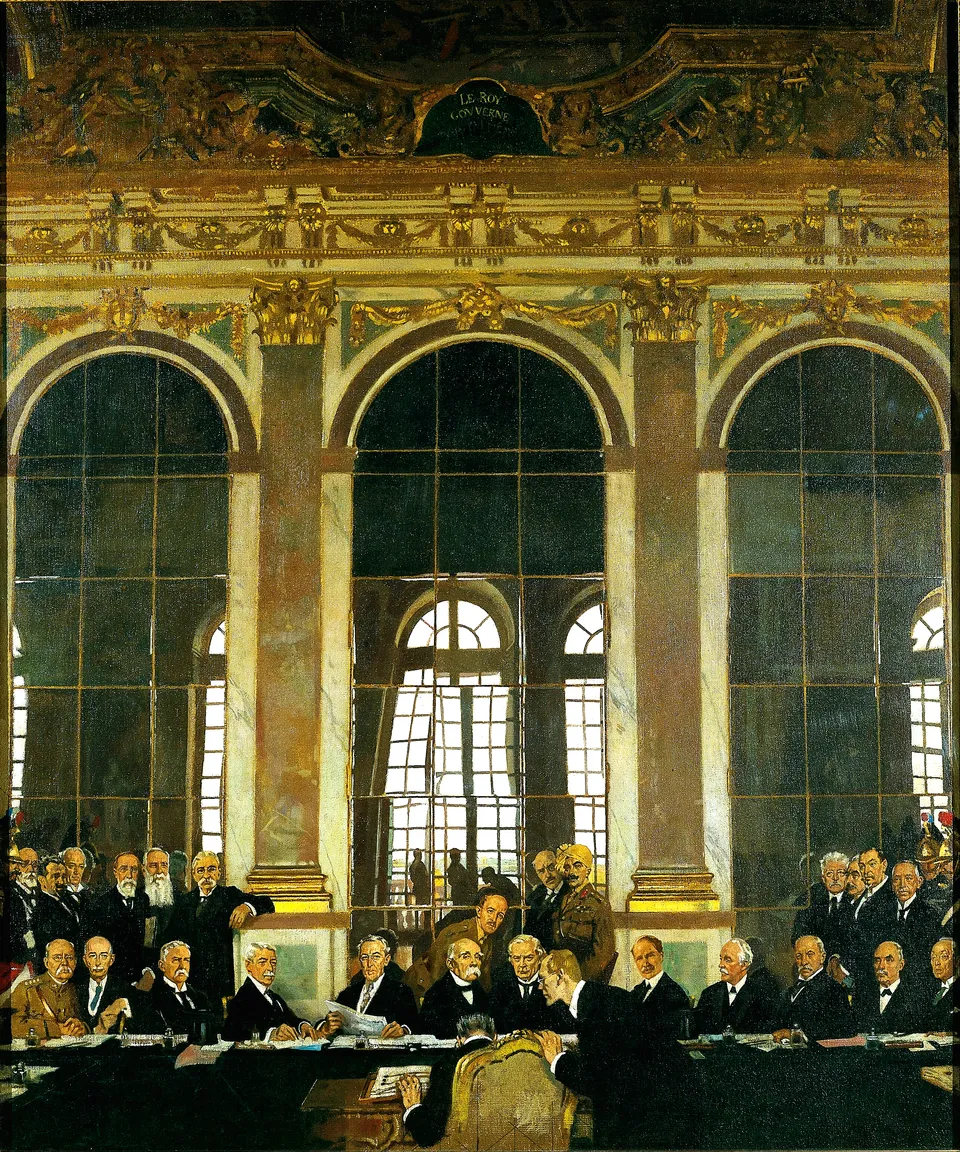
William Orpen · Public domain · Source
On 28 June 1919, five years to the day after the Sarajevo assassination, German delegates signed the treaty in the Hall of Mirrors at Versailles — the very room where the German Empire had been proclaimed 48 years earlier. Germany had been shut out of the negotiations and had to accept the terms as they stood.
Germany accepted responsibility for the war (Article 231) and returned Alsace-Lorraine to France; the Polish Corridor and the Free City of Danzig cut East Prussia off from the rest of the country, and all overseas colonies were lost. The army was cut to 100,000 men, with no conscription, air force, submarines or tanks, and the Rhineland was demilitarized. Reparations were fixed in 1921 at 132 billion gold marks.
Germans denounced the treaty as a dictated peace. The heavy reparations weighed on the economy, and the call to overturn the treaty helped the Nazis grow. The US Senate refused to ratify it, and the United States never joined the League of Nations.