Taiping Rebellion
Also called: Taiping Heavenly Kingdom
A peasant army led by Hong Xiuquan rose to "destroy the Manchus and restore the Han", set up the Taiping Heavenly Kingdom with Nanjing as its capital and defied the Qing for fourteen years until Han Chinese militias and Western-led troops crushed it.
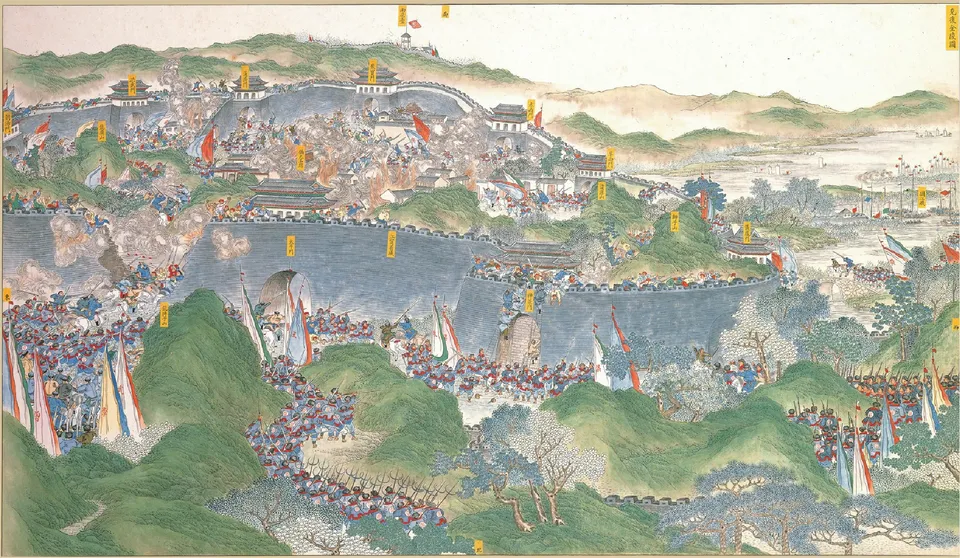
Wu Youru · Public domain · Source
After the Opium War, indemnities and soaring silver prices raised the tax burden while a growing population squeezed the peasantry. Hong Xiuquan, influenced by Christianity, founded the God Worshipping Society in Guangxi, rose at Jintian in 1851 and proclaimed the Taiping Heavenly Kingdom. His armies marched north and in 1853 took Nanjing, renaming it Tianjing, the Heavenly Capital.
The Taiping called for overthrowing the Manchu dynasty and restoring Han rule. They proclaimed an equal division of land (the Heavenly Land System), preached equality of men and women, and banned the queue, foot-binding and opium. But in 1856 the leadership tore itself apart in a bloody feud and the movement lost momentum.
The regular Qing forces were feeble, but militias raised by Han officials — Zeng Guofan’s Xiang Army and Li Hongzhang’s Huai Army — fought back, and the Western powers sided with the Qing, backing the Ever-Victorious Army. Hong died in 1864 and Tianjing fell. More than twenty million people are thought to have died. The Han officials who crushed the rebellion went on to lead the Self-Strengthening Movement.