The Five Hegemons of the Spring and Autumn Period
Also called: Spring and Autumn period, Five Hegemons
As the Zhou kings weakened, powerful lords such as Duke Huan of Qi and Duke Wen of Jin became hegemons who led the leagues of lords under the banner "honour the king, expel the barbarians".
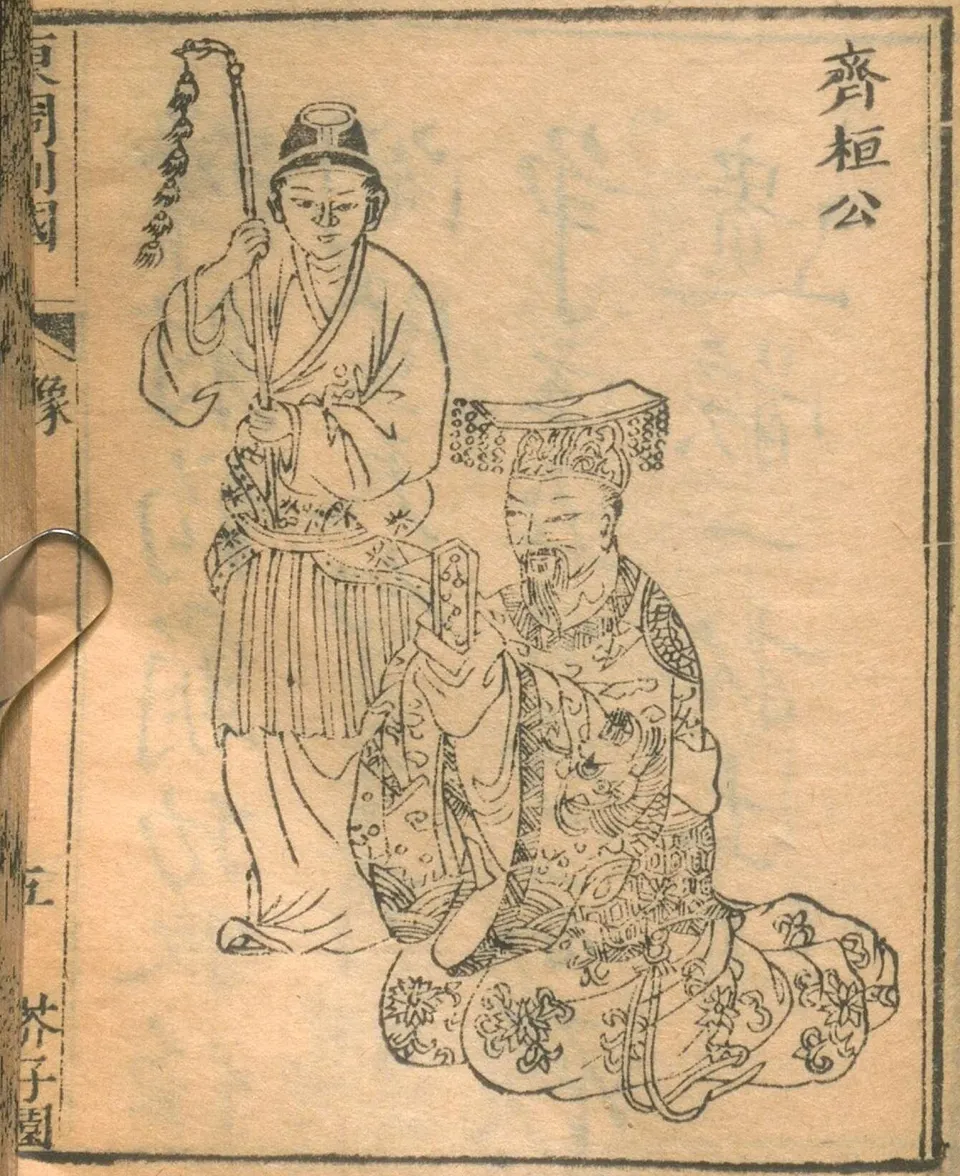
馮夢龍 · Public domain · Source
After Zhou moved its capital east, the king’s authority became nominal and the lords of the Spring and Autumn period fought one another without end. Powerful lords gathered the others into sworn leagues under the slogan "honour the Zhou king and expel the barbarians"; such a lord was called a hegemon (ba).
The first hegemon, Duke Huan of Qi, made his state rich with Guan Zhong as chief minister, promoting trade and the production of salt and iron, and confirmed his leadership at the league of Kuiqiu in 651 BCE. Duke Wen of Jin then defeated Chu at Chengpu in 632 BCE and became hegemon. The Five Hegemons are usually given as Duke Huan of Qi, Duke Wen of Jin, King Zhuang of Chu, King Helü (or Fuchai) of Wu and King Goujian of Yue, though some lists include Duke Mu of Qin and Duke Xiang of Song.
In these struggles the small states were swallowed by the large, and more than a hundred states shrank to a handful. Iron farm tools and ox-drawn ploughing began to spread at the end of the period. When the great state of Jin split into Han, Wei and Zhao in 403 BCE, the Warring States period began.