Confucius and Confucianism
Also called: Analects, Confucian school
Confucius of Lu taught that social order should be restored through benevolence (ren) and ritual propriety (li), founding the Confucian school. His disciples compiled his sayings as the Analects.
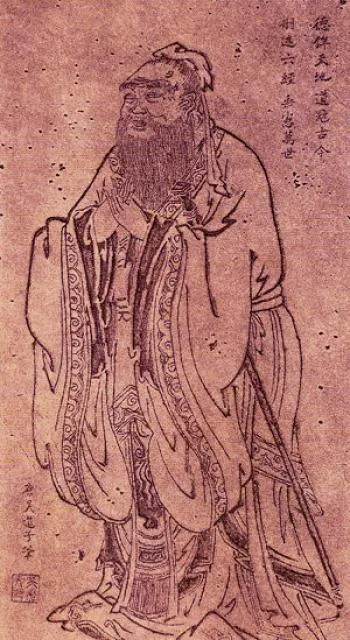
Wu Daozi , 685-758, Tang Dynasty. · Public domain · Source
Confucius was born in the state of Lu (today’s Qufu, Shandong) at the end of the Spring and Autumn period. Seeing lords and ministers flout the rites and fight one another, he called for a return to the order of the early Zhou. Its foundation was ren, a humane love for others, and li, its outward expression in ritual. Overcoming oneself to return to ritual, he said, was ren; he taught the rectification of names — let the ruler be a ruler, the minister a minister, the father a father and the son a son — and rule by virtue rather than punishment.
He held office in Lu but could not carry out his ideas, and spent fourteen years travelling among the states with his disciples trying to persuade their rulers, without success. Back home he taught pupils regardless of birth and is said to have edited old texts such as the Book of Songs and the Book of Documents. His disciples gathered his words and deeds into the Analects.
Confucianism passed to Mencius and Xunzi, became the state ideology under Emperor Wu of Han, and shaped the politics and ethics of East Asia for more than two thousand years. In Korea it was taught at Goguryeo’s Taehak, Silla’s Gukhak, Goryeo’s Gukjagam and Joseon’s Seonggyungwan, and Confucius was honoured in the shrines of the Seonggyungwan and the local hyanggyo schools.