Spanish Civil War
Also called: International Brigades
Army officers led by Franco rose against the Popular Front government, starting a civil war of almost three years. With Germany and Italy backing the rebels and the Soviet Union and the International Brigades aiding the Republic, it became a prelude to the Second World War.
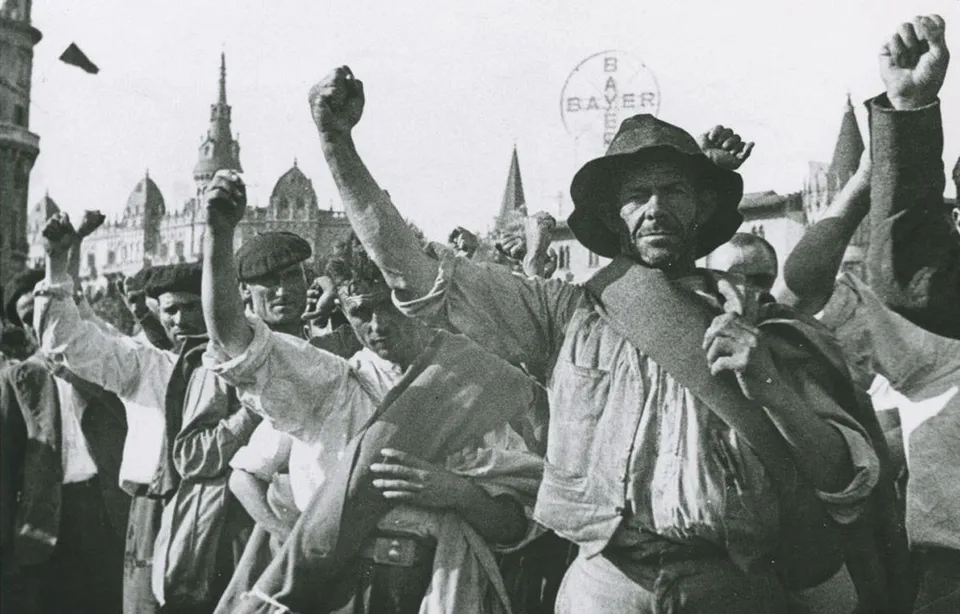
David Seymur · CC BY-SA 4.0 · Source
Spain became a republic when the monarchy fell in 1931, but left and right clashed bitterly over land reform, the Church and the army. After the Popular Front of republicans, socialists and communists won the election of February 1936, the army rose in Spanish Morocco on 17 July. General Franco became leader of the rebels (the Nationalists), backed by landowners, the Church, monarchists and the Falange.
Germany sent the Condor Legion and Italy tens of thousands of troops to help the rebels, while the Soviet Union supplied the Republican government with arms and advisers. Britain and France held to non-intervention. Volunteers from some fifty countries formed the International Brigades to fight for the Republic, among them writers such as Hemingway and Orwell. The Republican camp was weakened by feuds between communists and anarchists.
The Nationalists took Barcelona in January 1939 and Madrid in March, and Franco declared the war over on 1 April. Fighting and killings and executions on both sides cost hundreds of thousands of lives, and close to half a million people fled to France. Franco ruled as dictator until his death in 1975, and Germany and Italy, which had tested new weapons in Spain, drew still closer.