Spanish–American War and the Philippines
Also called: Spanish-American War, Philippine–American War
Intervening in Cuba’s war of independence, the US defeated Spain and took the Philippines, Guam and Puerto Rico. The Philippines declared independence but became an American colony after a war with the US.
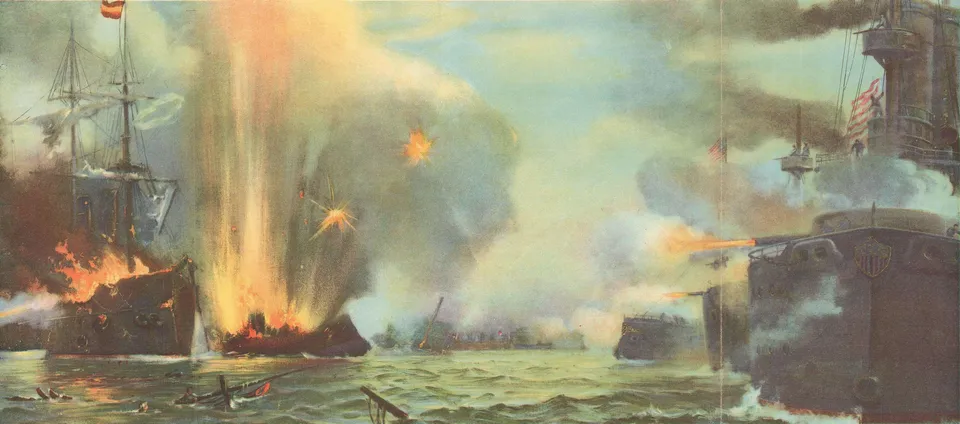
James Gale Tyler (1855–1931) · Public domain · Source
In 1895 Cubans rose in a war of independence against Spain. When the US battleship Maine exploded in Havana harbour on 15 February 1898, American newspapers blamed Spain and inflamed opinion, and in April the US declared war. On 1 May Dewey’s squadron destroyed the Spanish fleet in Manila Bay, and in July the Americans also won at Santiago de Cuba.
By the Treaty of Paris of 10 December Spain recognized Cuban independence and ceded the Philippines (for 20 million dollars), Guam and Puerto Rico to the US; Cuba itself became a virtual US protectorate under the Platt Amendment (1901). In the Philippines Aguinaldo, who had led a revolution against Spain since 1896, declared independence on 12 June 1898 and founded a republic, but the US refused to recognize it; after the Philippine–American War (1899–1902) the islands became an American colony.
Having annexed Hawaii the same year, the US became an imperial power reaching into the Pacific and Asia, and in 1899 it demanded an Open Door in China. In 1905, in the Taft–Katsura memorandum, the US and Japan acknowledged each other’s control of the Philippines and Korea.