Economy, Science and Technology of the Song
Also called: Three great inventions, Jiaozi, Champa rice
Under the Song the lower Yangtze was developed and the economic centre shifted south; commercial cities and paper money (jiaozi, huizi) appeared. The compass, gunpowder and movable-type printing came into practical use and spread across the world.
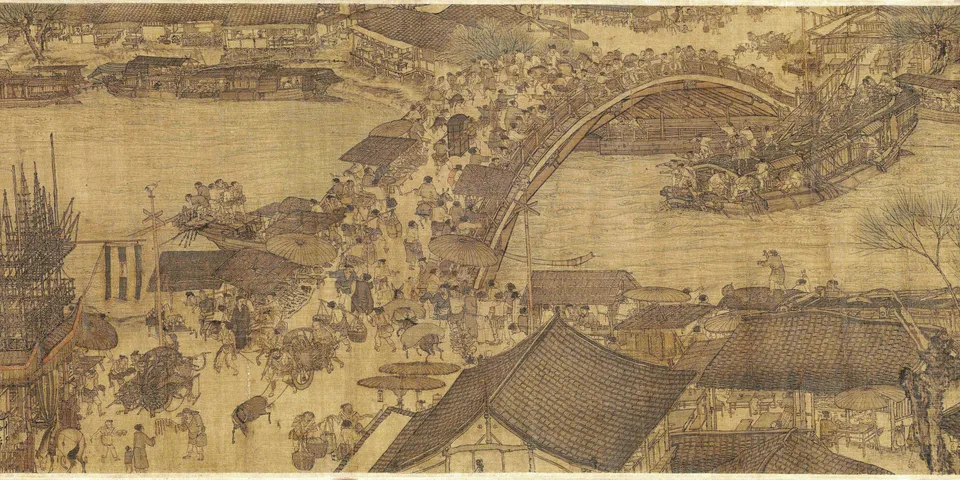
Zhang Zeduan · Public domain · Source
Fast-ripening, drought-resistant Champa rice spread under the Song and the marshes of the lower Yangtze were turned into paddy, so that by the Southern Song people said “when Suzhou and Huzhou ripen, the realm has enough”. The economic heart of China had moved south. In the cities trade was freed from fixed hours and markets, merchants formed guilds (hang) and artisans their own (zuo), and the jiaozi — promissory notes used by Sichuan merchants — were taken over and issued by the state from 1023 (the Southern Song issued huizi). Maritime trade offices at Guangzhou, Quanzhou and Mingzhou managed sea trade.
Science and technology advanced too. Shen Kuo’s Dream Pool Essays records Bi Sheng’s movable type of baked clay; the compass was used at sea by the early 12th century; and gunpowder went into fire lances and other weapons. All three reached Europe through the Islamic world and later shaped the voyages of discovery, the Reformation and early modern warfare. The porcelain of Jingdezhen, and the ci lyrics and variety plays enjoyed by townspeople, also belong to this age.
Song merchants called at Goryeo’s port of Byeongnando, and Goryeo took up Song ceramic techniques to develop its celadon. Goryeo’s metal movable type (the Sangjeong gogeum yemun and the Jikji) belongs to the same current of print culture.