Aristocratic Culture of the Wei, Jin and Southern and Northern Dynasties
Also called: Six Dynasties culture
Through the long division of the Wei, Jin and Southern and Northern Dynasties, great families who passed office down through the Nine-Rank system led society and created an aristocratic culture of “pure conversation”, Daoism and Buddhism, calligraphy, painting and literature.
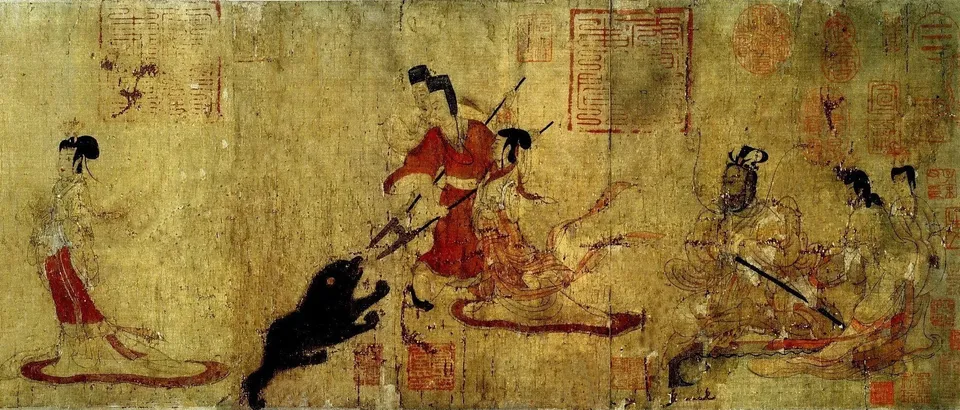
Gu Kaizhi (c.345-c.406) · Public domain · Source
Wei’s Nine-Rank system of 220 had local arbiters grade men into nine ranks for office, but it soon let powerful families hand high posts down the generations — “no humble families in the upper ranks, no great families in the lower”, as the saying went. When the Western Jin collapsed and the Eastern Jin was founded in the south in 317, northern aristocrats flooded south, and as the Southern Dynasties of Song, Qi, Liang and Chen ruled from Jiankang (today’s Nanjing), the Yangtze lands were rapidly developed.
“Pure conversation” on Laozi and Zhuangzi in place of politics became fashionable among aristocrats, and the age produced Tao Yuanming’s poem “Returning Home”, Wang Xizhi’s calligraphy of the Orchid Pavilion Preface, Gu Kaizhi’s painting Admonitions of the Court Instructress, the anthology Wenxuan compiled by Crown Prince Zhaoming of Liang, and ornate parallel prose. Buddhism spread widely through Kumarajiva’s translations, and Daoism, too, organised itself as a church.
Goguryeo and Baekje had close contacts with the Southern Dynasties as well; the brick tomb of King Muryeong of Baekje, built in the style of Liang, is the best-known example. The great families kept their power under Sui and Tang until they were swept away in the turmoil of the late Tang and Five Dynasties.