Religion18 October 1685

Revocation of the Edict of Nantes

Also called: Edict of Fontainebleau, Dragonnades

In 1685 Louis XIV revoked the Edict of Nantes with the Edict of Fontainebleau and outlawed Protestantism; hundreds of thousands of Huguenots fled to the Netherlands, England, Prussia and elsewhere.
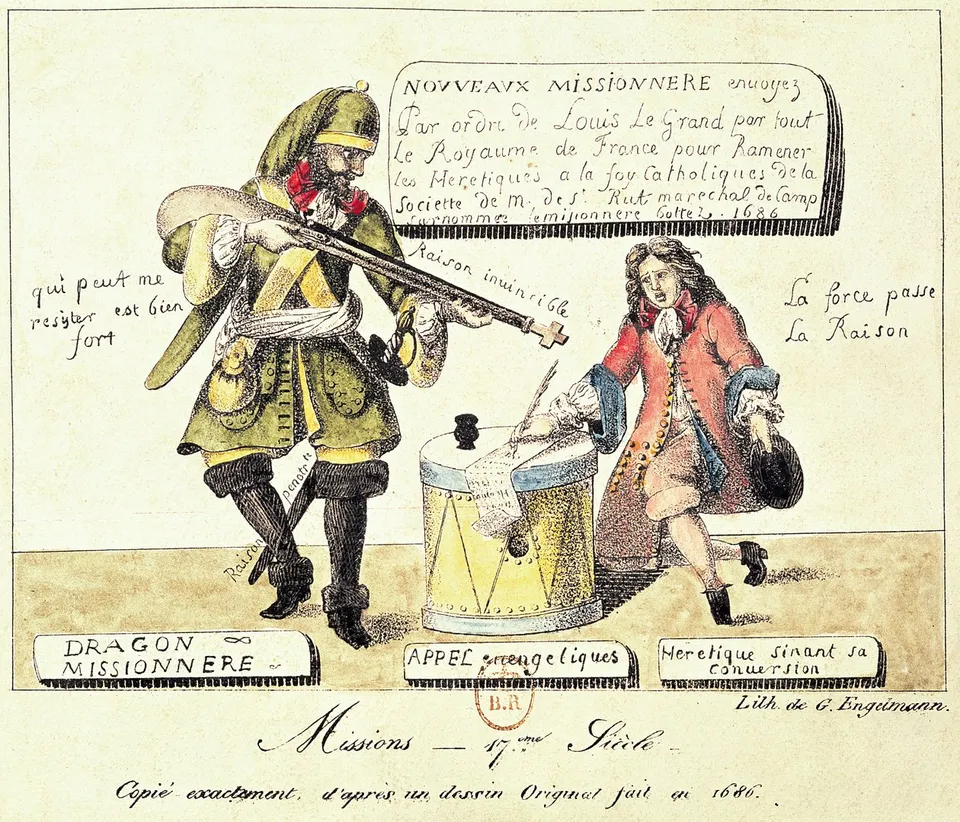
“The Missionary Dragoon” — print after a 1686 drawing satirising the dragonnades, which forced conversion at sword-point

Gottfried (Godefroy) Engelmann · Public domain · Source

Seeking “one king, one law, one faith”, Louis XIV forced Huguenots to convert by billeting dragoons in their homes (the dragonnades), and in October 1685 revoked the Edict of Nantes by the Edict of Fontainebleau. Some 200,000 Huguenots, many of them merchants and craftsmen, left for the Netherlands, England, Switzerland and Prussia, which issued an edict welcoming them. France lost skills and capital, while the countries that took them in saw their industries grow. Around the same time in Joseon, King Sukjong’s repeated changes of faction brought the Westerners and Southerners to power in turn.

The map in 1685

OpenFreeMap © OpenMapTiles © OpenStreetMap contributors

States at the time
France

People

  • Louis XIV1638 – 1715

    monarch · King of France (r. 1643–1715), the “Sun King” and model absolute monarch, who built Versailles and pursued mercantilism through Colbert

Before and after

Themes that include this event

  • Reformation and Absolutism1517 – 1796

    From Luther’s Ninety-five Theses to Catherine the Great — the wars of religion of a divided Christendom ended at Westphalia, and absolute monarchs armed with divine right, standing armies, bureaucracies and mercantilism, followed by the enlightened despots of eastern Europe, contended for the balance of power among sovereign states