The Administration of Darius I
Also called: Satrapy, Royal Road, Zoroastrianism, Behistun Inscription
Darius I divided the empire into some twenty provinces (satrapies) under governors (satraps), watched them through “the King’s Eyes and Ears”, and bound the empire together with the Royal Road and its relay stations.
Unknown author · Public domain · Source
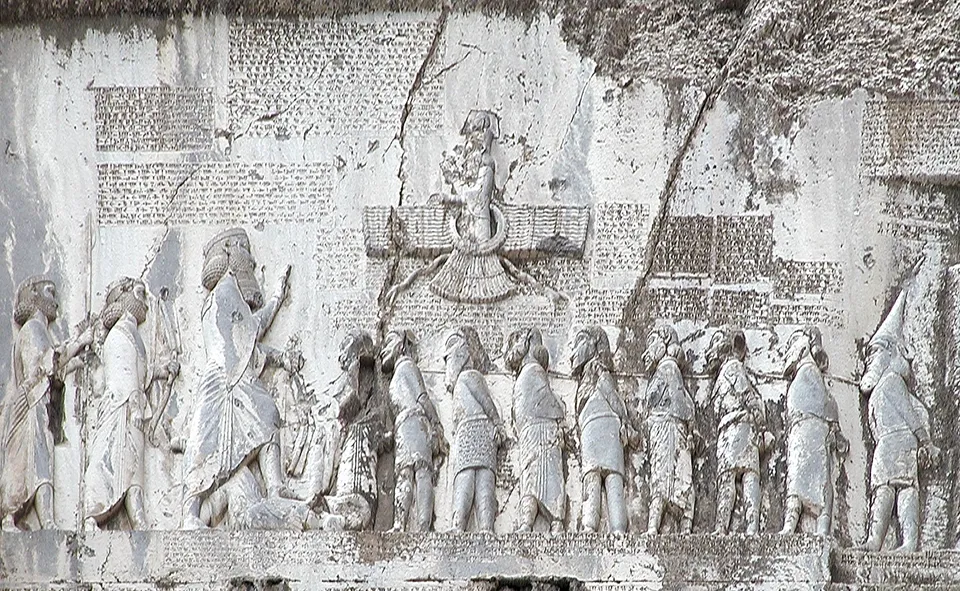
Crowned in 522 BC, Darius I put down revolts across the empire and recorded his deeds on the cliff at Behistun in three languages, Old Persian, Elamite and Babylonian; the inscription later became the key to deciphering cuneiform. He divided the empire into some twenty provinces governed by satraps and set inspectors known as “the King’s Eyes” and “the King’s Ears” to watch over them.
He built the Royal Road of some 2,500 km from the capital Susa to Sardis in Asia Minor, with relay stations to speed messages; minted gold coins; and standardized taxes, weights and measures to encourage trade. He also began the great palace at Persepolis.
Among the Persians spread Zoroastrianism, which saw the world as a struggle between the good god Ahura Mazda and an evil spirit and taught a final judgement. Darius too honoured Ahura Mazda in his inscriptions. This dualism of good and evil and the idea of judgement are thought to have influenced Judaism and Christianity. Darius’s campaigns against Greece led into the Persian Wars. On the Korean peninsula the Iron Age began around this time.