Politics21–22 September 1792

National Convention and the Proclamation of the Republic

Also called: National Convention, First French Republic, Girondins, Montagnards

Elected by universal male suffrage, the National Convention abolished the monarchy at its first sitting and began counting days from “Year I of the Republic”.
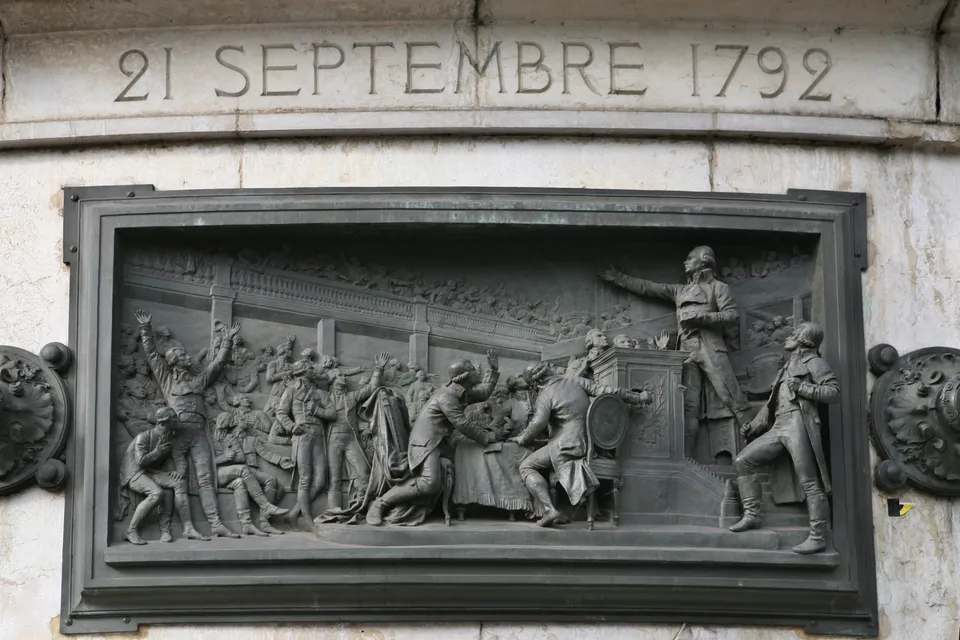
Proclamation of the abolition of the monarchy, 21 September 1792 — bronze relief by Léopold Morice on the Monument to the Republic, Place de la République, Paris, 1883

Roi Boshi · CC BY-SA 3.0 · Source

The National Convention first met on 20 September 1792 and on 21 September unanimously abolished the monarchy. From 22 September official documents were dated “Year I of the French Republic”, and that day later became the first day of the revolutionary calendar. In December the Convention declared the Republic “one and indivisible”.

Within the Convention the Girondins, who spoke for the provincial bourgeoisie, faced the Montagnards (the Jacobins Robespierre, Danton and Marat), close to the Paris crowd, with the uncommitted Plain between them. They clashed over the king’s trial, the war and the place of Paris, and in June 1793 the Paris crowd surrounded the Convention and forced out the Girondin deputies, leaving the Montagnards in power.

The map in 1792

OpenFreeMap © OpenMapTiles © OpenStreetMap contributors

States at the time
France · established
Places
Paris

People

  • Maximilien Robespierre1758 – 1794

    participant · Jacobin leader who dominated the Committee of Public Safety during the Reign of Terror and was guillotined after the Thermidorian Reaction of 1794

  • Georges Danton1759 – 1794

    participant · Revolutionary orator who led France as Minister of Justice in the crisis of 1792 and was guillotined in 1794 after calling for an end to the Terror

  • Jean-Paul Marat1743 – 1793

    participant · Physician turned journalist and Convention deputy whose paper L’Ami du peuple urged radical revolution; assassinated by Charlotte Corday in 1793

Before and after

Themes that include this event

  • The French Revolution1787 – 1799

    From the Assembly of Notables and the Estates-General to the coup of 18 Brumaire — twelve years that toppled the absolute monarchy, founded a republic, passed through Terror and reaction, and ended with Napoleon