Gilt-bronze Pensive Maitreya Bodhisattva
Also called: Pensive Bodhisattva, Maitreya in Meditation
Three Kingdoms gilt-bronze bodhisattvas sitting with one leg crossed over the other knee and a finger to the cheek, lost in thought. Two National Treasures are in the National Museum of Korea.
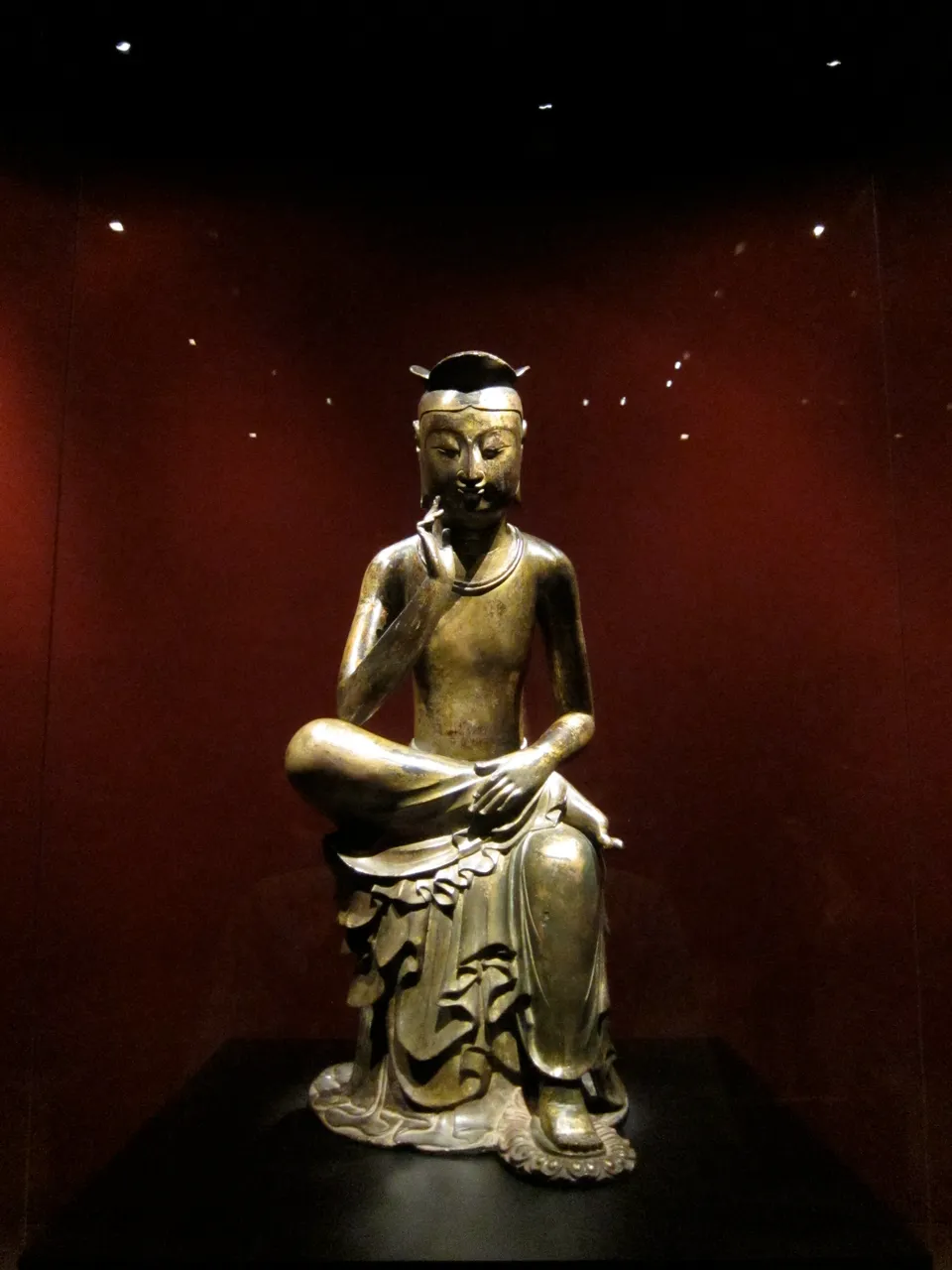
A pensive bodhisattva sits on a seat with the right foot resting on the left knee (bange) and the fingertips of the right hand lightly touching the cheek, sunk in thought (sayu). In the Three Kingdoms it was linked to the Maitreya faith and taken as Maitreya. Two gilt-bronze examples are National Treasures: one wearing an ornate sun-and-moon crown (late 6th century) and one 93.5 cm tall with a crown of three rounded peaks (early 7th century).
The figure with the triple-peaked crown closely resembles the wooden pensive Maitreya of Kōryū-ji in Kyoto, and is cited as evidence that Three Kingdoms Buddhist art reached Japan. As their find-spots are unknown, scholars differ on whether they were made in Silla or in Baekje. The two now sit side by side in the "Room of Quiet Contemplation" of the National Museum of Korea.