Pax Romana and the Five Good Emperors
Also called: Roman Peace, Five Good Emperors
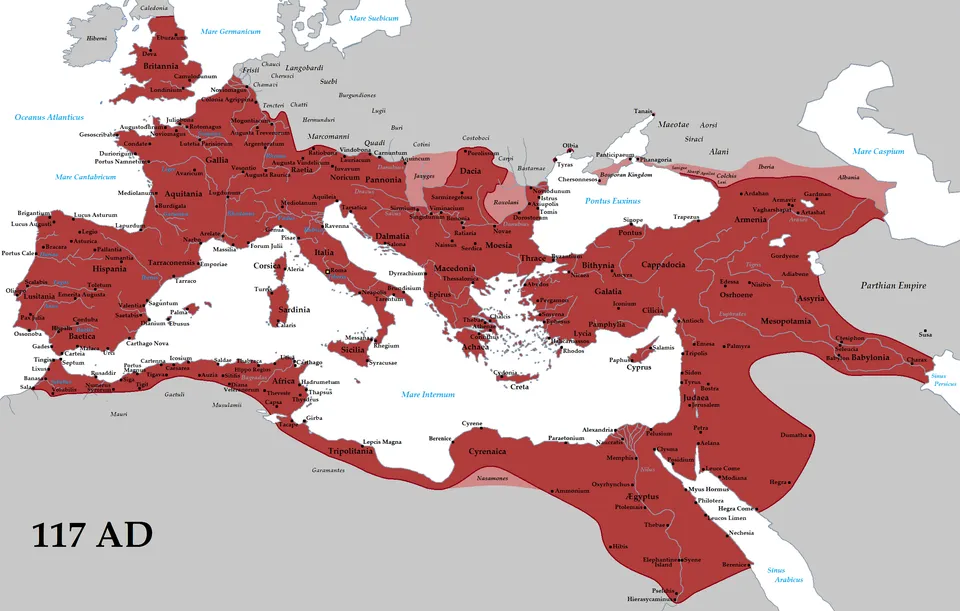
For about two centuries from Augustus the Roman Empire enjoyed peace without major wars. It reached its height under the Five Good Emperors, and its greatest extent under Trajan.
Tataryn · CC BY-SA 3.0 · Source
The peace that lasted some two hundred years after Augustus founded the principate is called the Pax Romana, the Roman Peace. It culminated in the age of the Five Good Emperors (96–180) — Nerva, Trajan, Hadrian, Antoninus Pius and Marcus Aurelius — who passed the throne to capable men they adopted. Under Trajan in 117 the empire stretched from Britain to Mesopotamia, its greatest extent, and Hadrian built a wall in northern Britain to guard the frontier.
Trade flowed along the empire’s roads and sea lanes, and cities gained amphitheatres, public baths and aqueducts. The civil law that had applied only to Roman citizens broadened into the law of nations (ius gentium) used by the empire’s many peoples, forming the basis of Roman law. Marcus Aurelius, a Stoic philosopher, wrote the Meditations.
The Book of the Later Han records that in 166 envoys arrived from “Andun, king of Daqin” (Rome); many identify Andun with Marcus Aurelius Antoninus. Roman glassware later travelled along the steppe route as far as Silla tombs such as Hwangnam Daechong. After Marcus Aurelius’ death the empire slid into the turmoil of the third century.